Paper

When EOS Tokens Disagree: Understanding Length Inflation in On-Policy Distillation

Treats multiple EOS tokens as one semantic stop action in OPD, rather than supervising them as distinct tokens. This reduces mismatch-driven overgeneration.

arXiv ↗Sep 17, 2026Code ↗

  • llm
  • distillation
  • language modeling
  • alignment
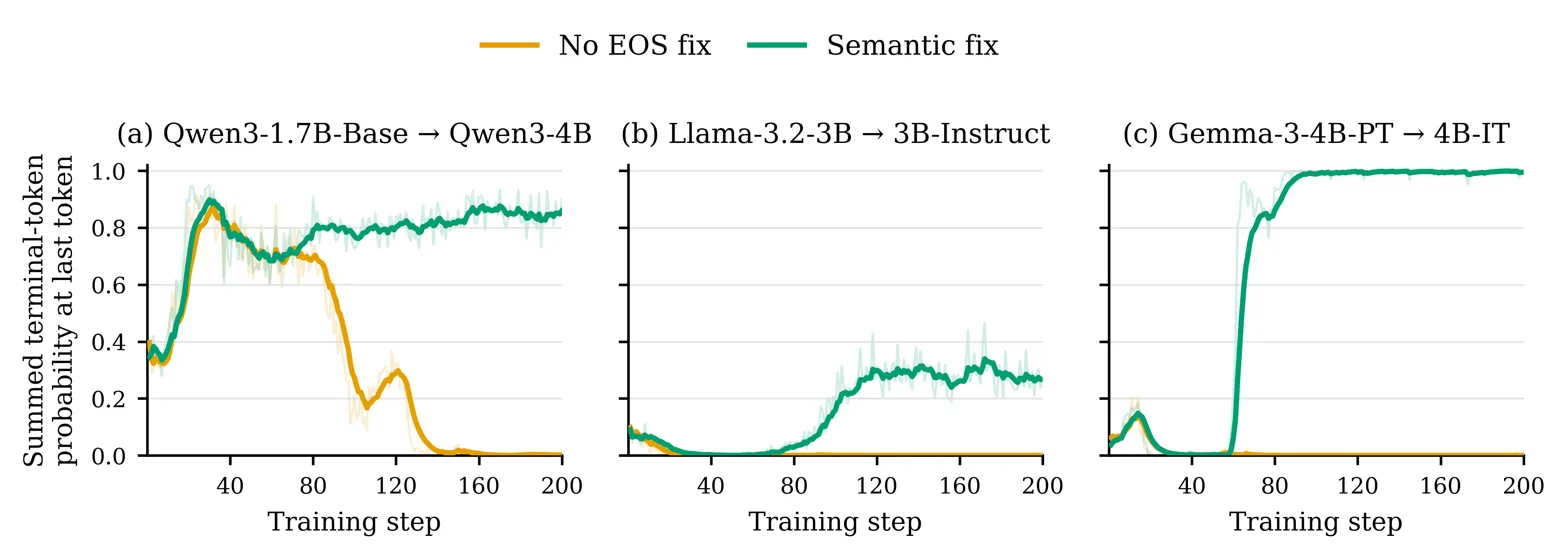
Comparative results across three models showing semantic fix vs no-fix, core claim

What it is

Analyzes why on-policy distillation makes students over-generate: teacher and student often disagree on which EOS token means stop. It fixes this by supervising EOS tokens as one semantic stop action. Instead of only matching sampled surface tokens, it merges functionally equivalent EOS tokens into one semantic stop action. This targets a failure prior work missed: teacher and student can prefer different EOS tokens even with the same declared stop set.

Key results

  • Across Qwen3, Llama 3.2, and Gemma 3, EOS aggregation mitigates length inflation
  • On Qwen3, shared-stop decoding alone tracks vanilla OPD and fails to fix clipping
  • In Qwen3, student prob. of teacher-preferred <|im_end|> is ~1e-11 near terminal states

Length inflation in OPD can come from tokenization-level disagreement about how to stop, not just broader optimization instability.

One useful ML email a week.

Worth your time, not all of your time.

We track new ML work across papers, code, and data, then keep only the pieces worth a closer look. Selected, not collected.

Papers.Data.Code

The Weekly ML Signal

Selected, not collected.

One useful ML email a week: the papers, repos and datasets worth your attention.

Worth your time, not all of your time.