Paper

RynnBrain 1.1: Towards More Capable and Generalizable Embodied Foundation Model

Adds manipulation-aligned outputs to embodied pretraining via contact points and 3D boxes, then fine-tunes one masked action space across different robots.

arXiv ↗Jul 20, 2026Code ↗

  • robotics
  • vision-language-action
  • 3d grounding
  • robot manipulation
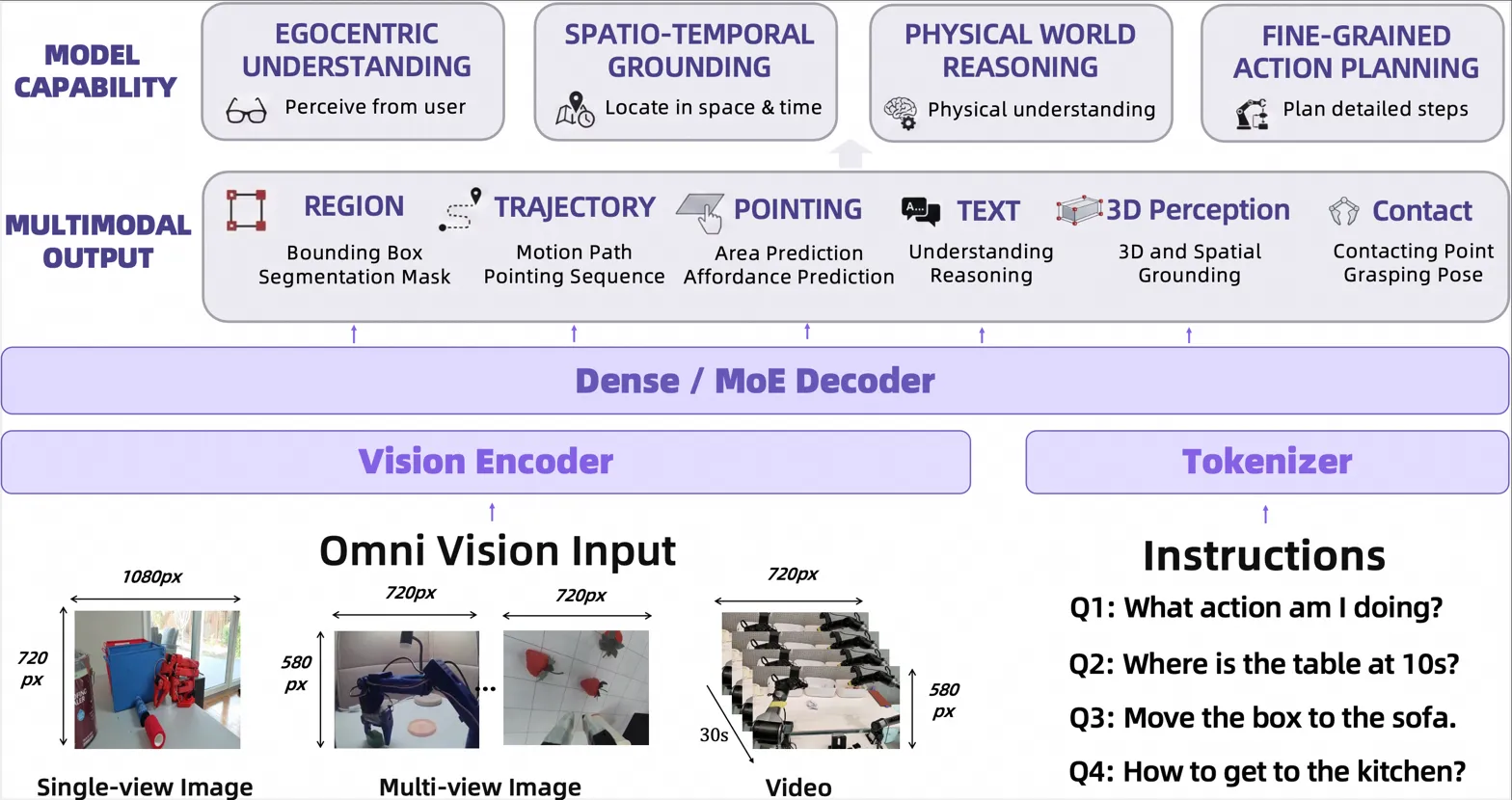
Full model pipeline: vision input, encoder, decoder, outputs, and capabilities diagram

What it is

Embodied foundation models with native 3D grounding, contact-point prediction, and a cross-embodiment VLA action space for real robots. Instead of stopping at 2D grounding and per-robot action heads, it adds contact-point prediction and native 3D grounding in pretraining, then uses one cross-embodiment action space with robot-specific masking for VLA fine-tuning.

Key results

  • 122B-A10B outperforms all evaluated models on VSI-Bench
  • 122B-A10B outperforms all evaluated models on MMSI
  • 122B-A10B outperforms all evaluated models on RefSpatial-Bench

Manipulation-aligned grounding plus shared cross-embodiment action modeling transfers better to heterogeneous real-robot policies than generic VLM initialization.

One useful ML email a week.

Worth your time, not all of your time.

We track new ML work across papers, code, and data, then keep only the pieces worth a closer look. Selected, not collected.

Papers.Data.Code

The Weekly ML Signal

Selected, not collected.

One useful ML email a week: the papers, repos and datasets worth your attention.

Worth your time, not all of your time.