Paper

Self Gradient Forcing: Native Long Video Extrapolation

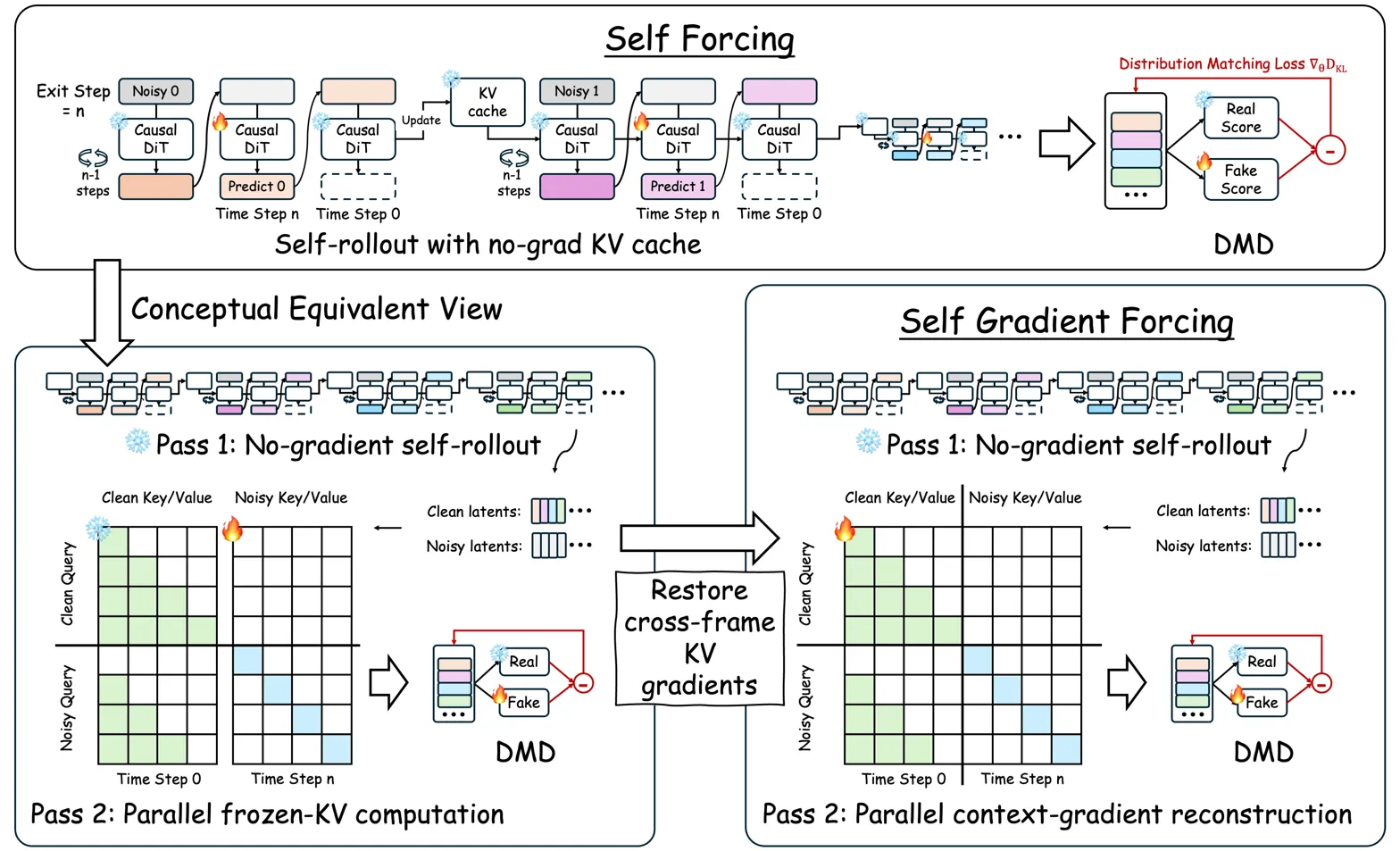
Instead of frozen-cache self-rollout training, it adds a second reconstruction pass so future-frame losses update how self-generated context is encoded into KV memory.

arXiv ↗Jul 22, 2026Code ↗

  • cv
  • video generation
  • diffusion models
  • autoregressive modeling
Method pipeline diagram showing Self Forcing and Self Gradient Forcing approaches

What it is

A two-pass training scheme for autoregressive video diffusion that lets future losses train how self-generated history is written into KV memory for long video rollout. Unlike Self Forcing, which trains on self-rollouts but freezes historical KV cache writes, SGF replays a sampled rollout step in a parallel second pass so future losses supervise clean-timestep KV memory writing without full rollout backprop.

Key results

  • Matches Self Forcing on 5s VBench short-horizon evaluation
  • Improves over Self Forcing at 60s native long-video extrapolation
  • Improves over Self Forcing at 240s and extrapolates to several minutes

Long-horizon video consistency depends not just on reading past cache, but on training how self-generated history is written into causal memory.

One useful ML email a week.

Worth your time, not all of your time.

We track new ML work across papers, code, and data, then keep only the pieces worth a closer look. Selected, not collected.

Papers.Data.Code

The Weekly ML Signal

Selected, not collected.

One useful ML email a week: the papers, repos and datasets worth your attention.

Worth your time, not all of your time.