Paper

Scaling Parameter-Efficient Fine-Tuning for Brain Encoding

PEFT for brain encoding: adapt large multimodal backbones with LoRA, using causal single-pass extraction instead of costly sliding windows.

arXiv ↗Oct 19, 2026Code ↗

  • llm
  • multimodal
  • brain encoding
  • lora
  • fmri
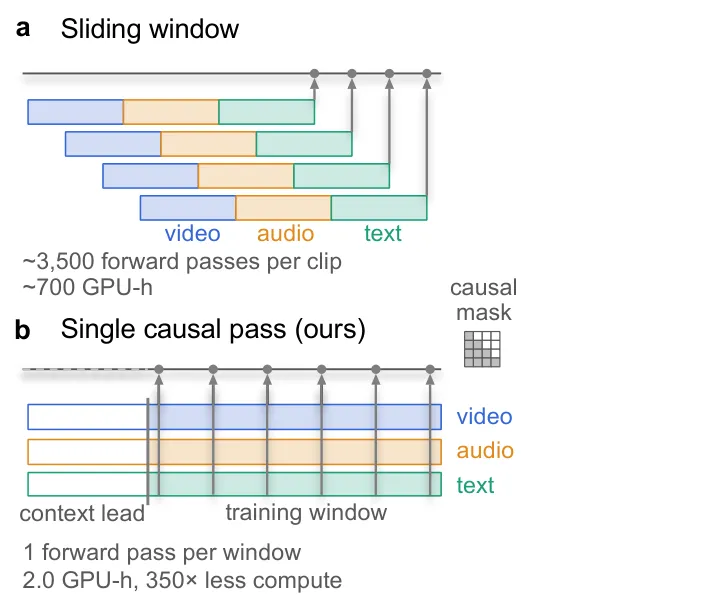
Method diagram contrasting sliding window vs single causal pass, showing core efficiency contribution

What it is

LoRA-adapts huge multimodal backbones for brain encoding, making fine-tuning practical with single-pass causal extraction and multi-LoRA training. Instead of frozen backbones plus giant readouts, it PEFT-adapts pretrained multimodal models with small LoRAs; causal single-pass extraction replaces sliding windows, enabling adaptation up to 104B params and large adapter ensembles.

Key results

  • 0.327 ID and 0.228 OOD, beating MIRAGE's 0.310/0.217 single model
  • 261-model ensemble scores 0.343 ID and 0.248 OOD, top public leaderboard
  • Single-pass extraction cuts feature cost about 350x vs prior sliding-window setup

Shows small neural-data adapters can beat frozen-backbone systems with much larger readouts for whole-brain encoding.

One useful ML email a week.

Worth your time, not all of your time.

We track new ML work across papers, code, and data, then keep only the pieces worth a closer look. Selected, not collected.

Papers.Data.Code

The Weekly ML Signal

Selected, not collected.

One useful ML email a week: the papers, repos and datasets worth your attention.

Worth your time, not all of your time.