Paper

Terminal-Universe: Turning Agent Trajectories into Scalable Terminal Environments

Turns terminal-agent trajectories into reusable executable workspaces by replaying edits and filling gaps, then generates verified new coding tasks on top.

arXiv ↗Sep 3, 2026Code ↗

  • llm
  • nlp
  • code agents
  • synthetic data
  • agent training
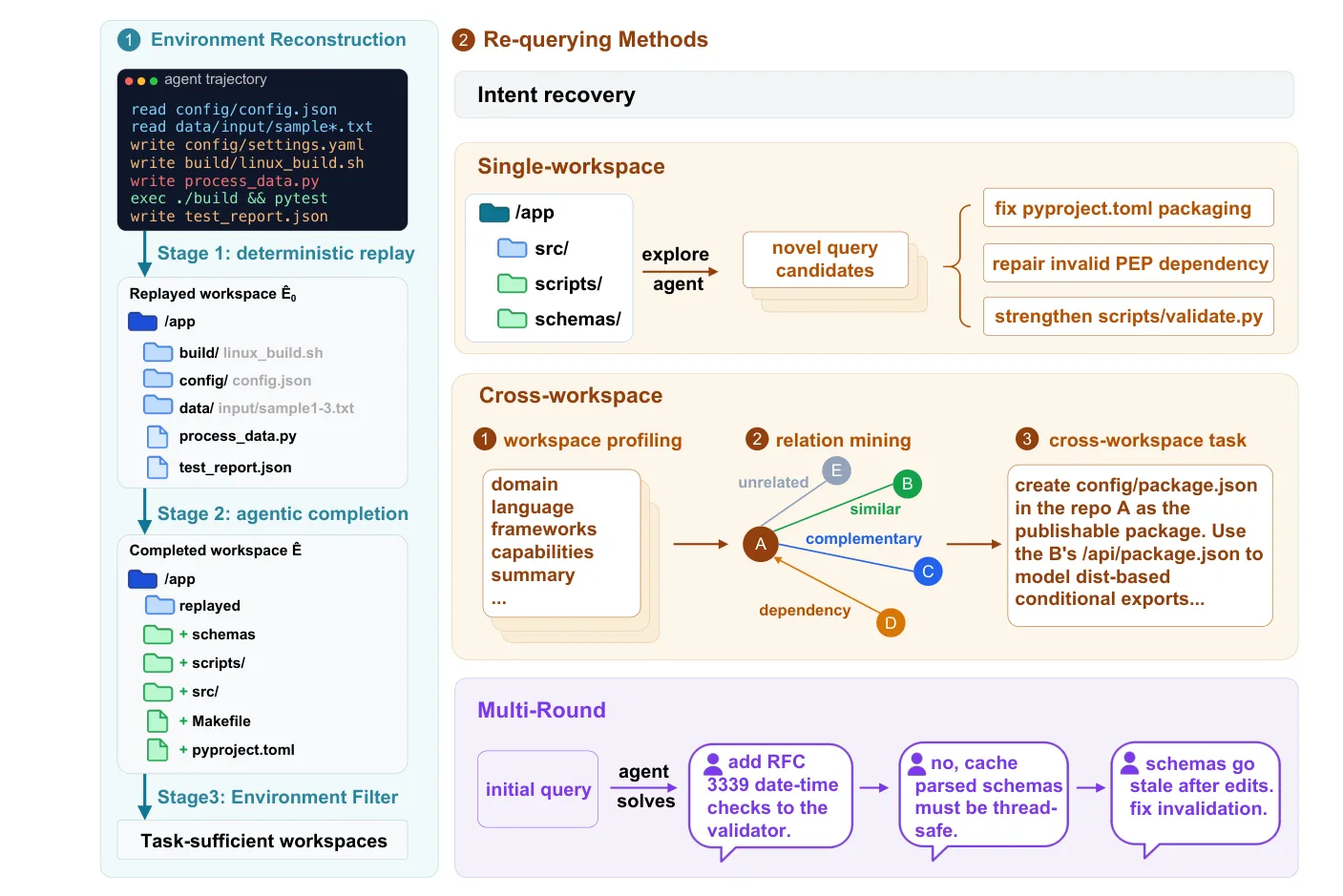
Pipeline diagram showing environment reconstruction and re-querying methods, the core method.

What it is

Reconstructs executable terminal coding environments from agent trajectories, then re-queries them to generate scalable verified training tasks. Instead of treating trajectories as fixed demos, reconstruct the underlying workspace from tool history, complete missing context, then synthesize verified single-WS, cross-WS, and multi-round tasks from it.

Key results

  • 37.3k task-sufficient environments reconstructed from public trajectories
  • Qwen3.5-27B gains +11.9 on Terminal-Bench 2.1 after SFT
  • Qwen3.5-27B gains +13.8 on EvoCode-Bench v2 MT@4

Shows reconstructed environments are a much more scalable and useful training resource than raw trajectory imitation for terminal code agents.

One useful ML email a week.

Worth your time, not all of your time.

We track new ML work across papers, code, and data, then keep only the pieces worth a closer look. Selected, not collected.

Papers.Data.Code

The Weekly ML Signal

Selected, not collected.

One useful ML email a week: the papers, repos and datasets worth your attention.

Worth your time, not all of your time.