Paper

Show-Harness: Just a VLM Agent Can Play Robots

Rather than learn robot-specific controls, a VLM issues discrete semantic moves and gripper commands that per-robot interpreters execute deterministically.

arXiv ↗Sep 9, 2026Code ↗

  • robotics
  • llm
  • cv
  • multimodal
  • robot manipulation
  • vision-language models
  • imitation learning
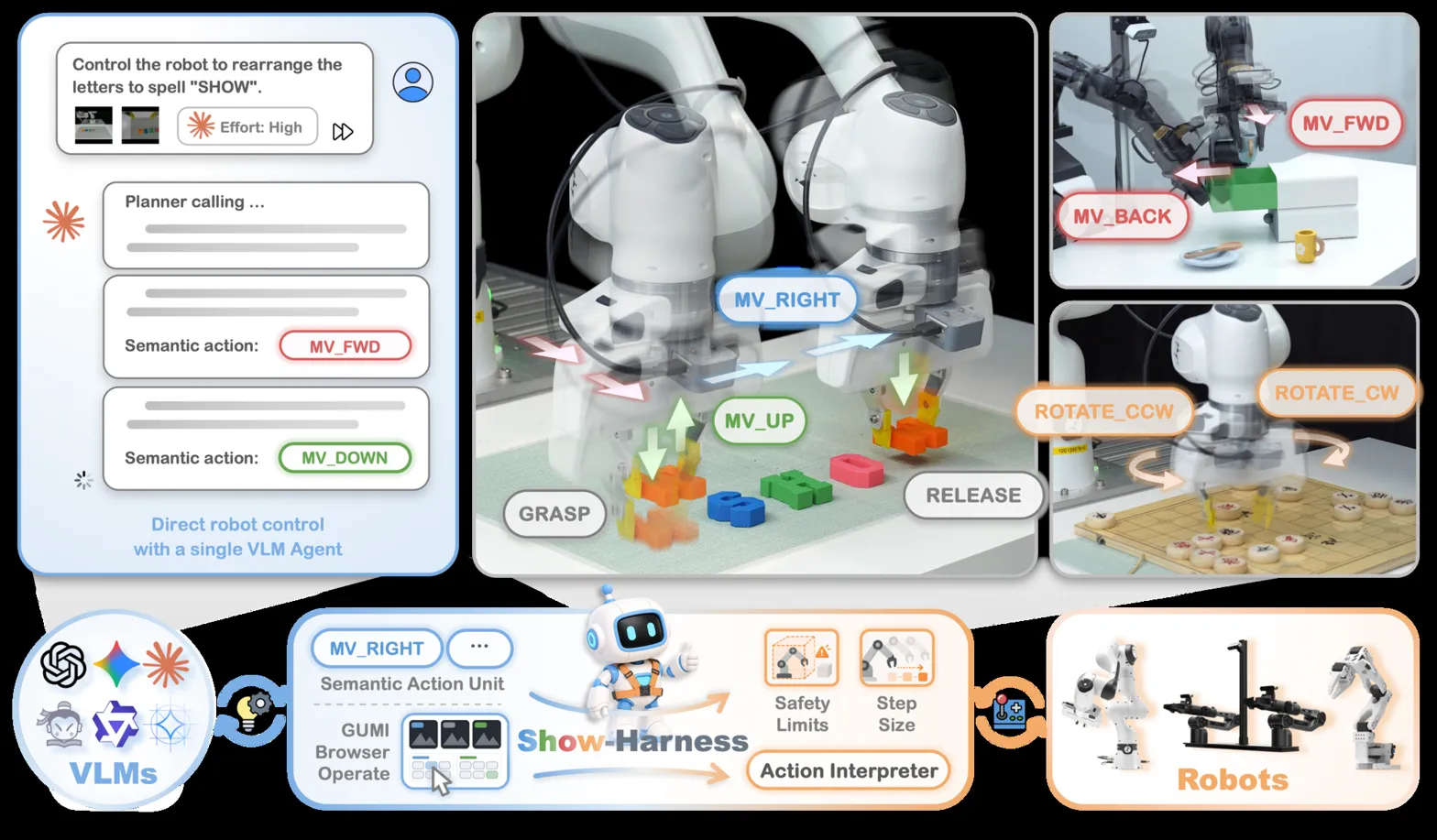
Pipeline diagram showing VLM-to-robot control system with semantic actions and demos

What it is

A semantic action harness lets VLMs directly control robots via discrete, interpretable moves, enabling zero-shot frontier-model control and cheap fine-tuning of small VLMs. Instead of regressing embodiment-specific motor actions or calling opaque skills, VLMs emit fine-grained semantic action units that deterministic interpreters ground on each robot.

Key results

  • Outperforms representative agentic paradigms across tasks and embodiments
  • Beats representative VLA baselines under controlled generalization tests
  • Shows strong sim-to-real transfer with small VLMs fine-tuned in a few GPU-hours

A compact semantic action interface can preserve VLM reasoning while still supporting direct, fine-grained physical control.

One useful ML email a week.

Worth your time, not all of your time.

We track new ML work across papers, code, and data, then keep only the pieces worth a closer look. Selected, not collected.

Papers.Data.Code

The Weekly ML Signal

Selected, not collected.

One useful ML email a week: the papers, repos and datasets worth your attention.

Worth your time, not all of your time.