Paper

Text Template Tokens Are Implicit Semantic Registers in Diffusion Transformers

A causal interpretability study shows structural chat-template tokens, not prompt tokens, maintain object identity in DiTs and yields a pruning rule.

arXiv ↗Jul 21, 2026Code ↗

  • multimodal
  • diffusion transformers
  • interpretability
  • attention pruning
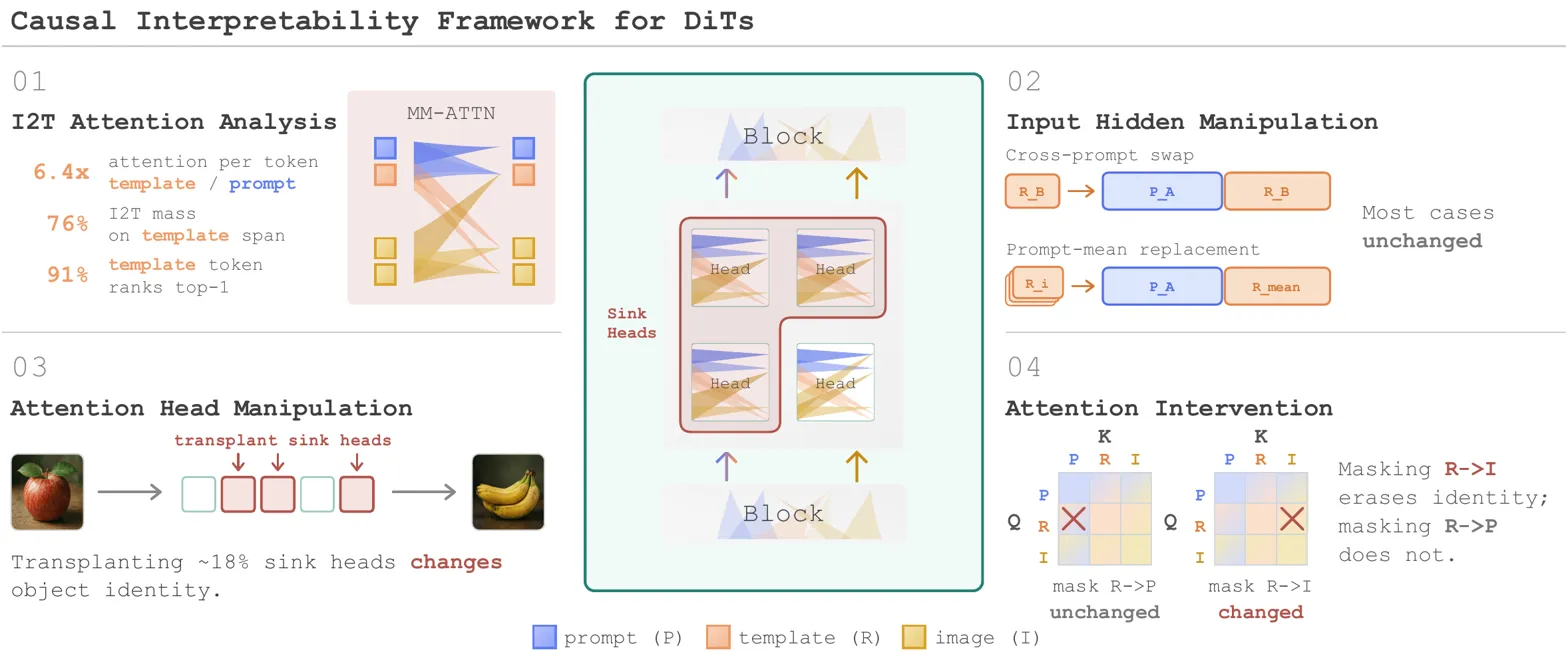
Framework overview with four labeled analysis/method components explaining the causal interpretability approach

What it is

A causal analysis of text-to-image DiTs finds chat-template tokens, not prompt tokens, become the main semantic carriers during denoising and enable pruning. Instead of treating chat-template tokens as inert formatting, the paper shows they become semantic registers inside DiTs: image latents write object identity into them, while prompt-reading heads are largely dispensable and can be pruned.

Key results

  • Pruning prompt-attending heads cuts 20% attention FLOPs for only -1.4 GenEval
  • On GenEval, template tokens get 76% of I2T attention in Qwen-Image
  • Per-token template attention is 6.4x prompt-token attention on GenEval

In joint-attention DiTs, the tokens that encode semantics at input need not be the tokens that preserve semantics during generation.

One useful ML email a week.

Worth your time, not all of your time.

We track new ML work across papers, code, and data, then keep only the pieces worth a closer look. Selected, not collected.

Papers.Data.Code

The Weekly ML Signal

Selected, not collected.

One useful ML email a week: the papers, repos and datasets worth your attention.

Worth your time, not all of your time.