Paper

Confidence Comes from Experience: Experiential Confidence Estimation from Reasoning to Agents

Uses retrieved graded past episodes to recalibrate a model's stated confidence, combining historical hit rate with a brief reflection pass.

arXiv ↗Sep 15, 2026Code ↗

  • nlp
  • llm
  • uncertainty estimation
  • calibration
  • agents
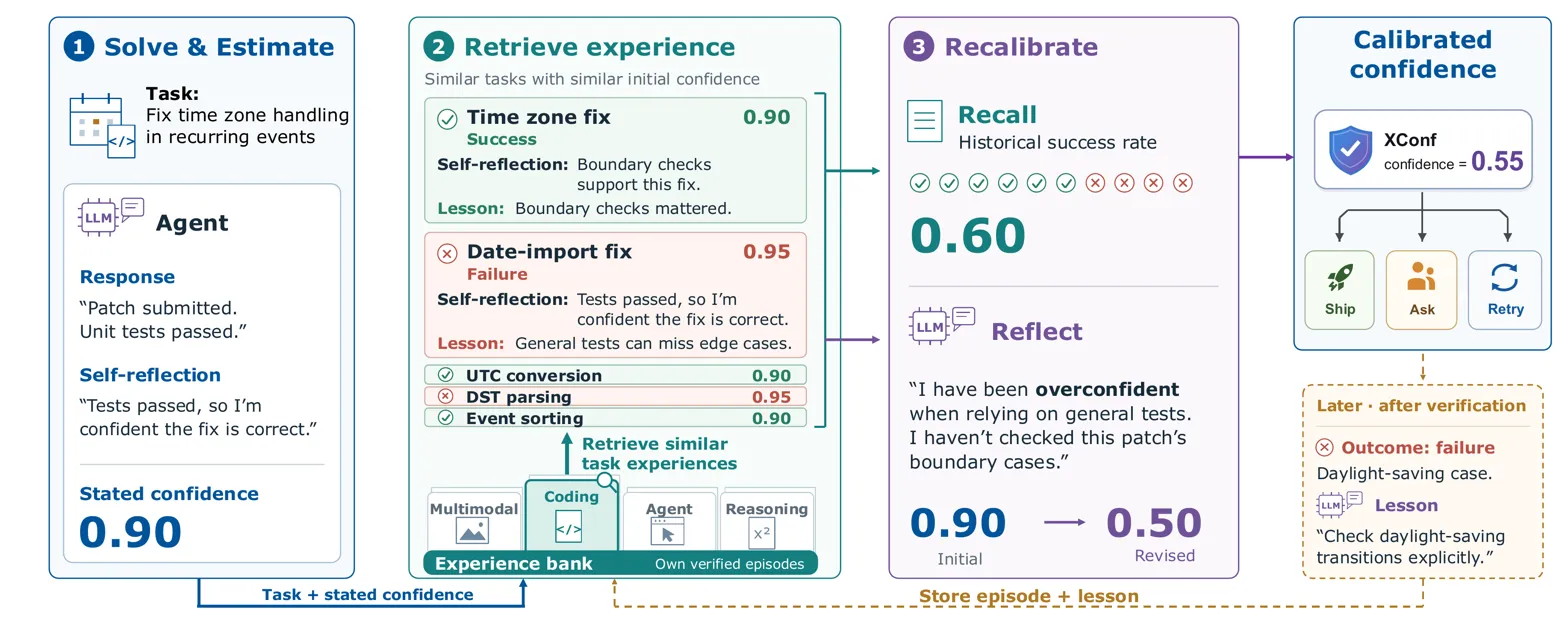
Pipeline diagram showing confidence recalibration method with retrieval and reflection stages.

What it is

Confidence estimation from a model's own graded history: retrieve similar past episodes, read their hit rate, and revise stated confidence with one extra reflection. Instead of estimating confidence from only the current trace or resampling, it uses the model's own verified past episodes. It retrieves similar tasks with similar stated confidence, reads off historical success, then has the model restate confidence from that track record.

Key results

  • AUROC beats or matches SC@10 on 23/24 model-benchmark comparisons
  • Lower ECE than SC@10, with 3-8x lower error on MMLU-Pro
  • Abstaining on the bottom 10% confidence raises agent success by up to 8.7 pts

A model's own verified experience is a stronger and cheaper basis for confidence than re-reading or resampling the current inference alone.

One useful ML email a week.

Worth your time, not all of your time.

We track new ML work across papers, code, and data, then keep only the pieces worth a closer look. Selected, not collected.

Papers.Data.Code

The Weekly ML Signal

Selected, not collected.

One useful ML email a week: the papers, repos and datasets worth your attention.

Worth your time, not all of your time.