Paper

Bilevel Coordinated Reflection: A Game-Theoretic Approach to Multi-Agent LLM Systems

Verifier-gated reflection replaces transcript-only self-critique: commit memory only if grounded eval risk drops, with bilevel game analysis for coordination.

arXiv ↗Sep 2, 2026Code ↗

  • llm
  • multi-agent systems
  • test-time adaptation
  • theory
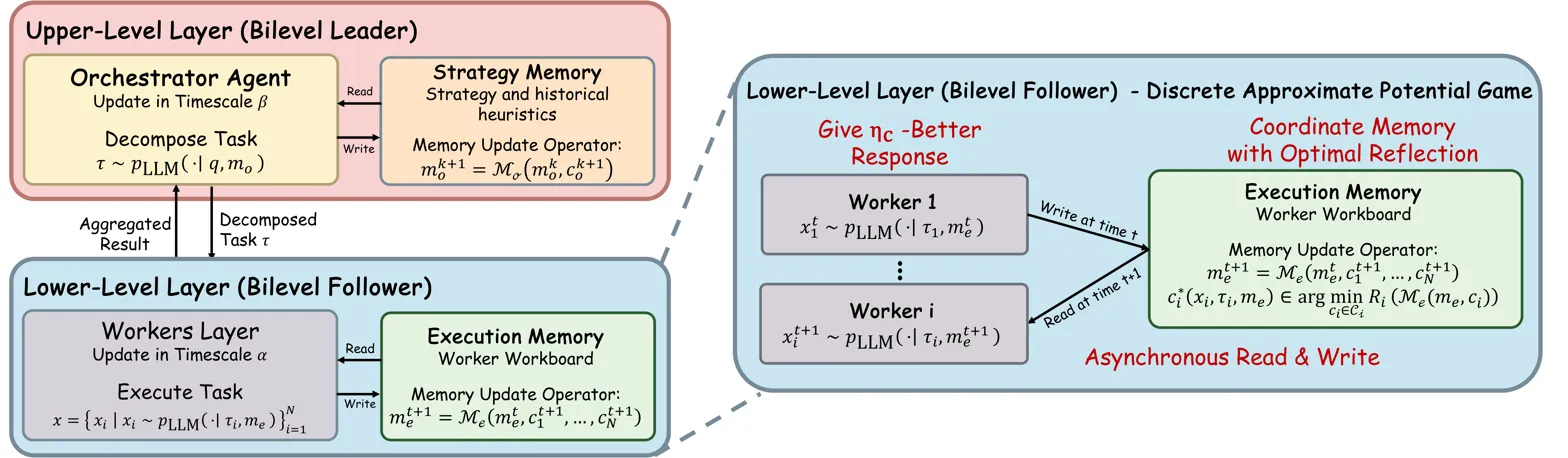
Bilevel multi-agent architecture diagram showing leader/follower layers and memory operators

What it is

Frames orchestrator-worker LLM systems and reflection as a bilevel game, then adds verifier-gated memory updates with convergence guarantees and SWE-bench gains. Instead of unguided self-reflection or text-only judging, memory edits are accepted only when an environment-grounded verifier lowers risk. The paper also models orchestrator-worker coordination as a bilevel approximate potential game, tying decomposition quality to coordination slack.

Key results

  • 72.2% resolved on 500 SWE-bench, vs 70.8% mini-SWE-agent v2
  • 361/500 SWE-bench instances resolved by the full Kimi-based system

Shows grounded verification is necessary for reliable reflective memory improvement when correctness depends on external environment state.

One useful ML email a week.

Worth your time, not all of your time.

We track new ML work across papers, code, and data, then keep only the pieces worth a closer look. Selected, not collected.

Papers.Data.Code

The Weekly ML Signal

Selected, not collected.

One useful ML email a week: the papers, repos and datasets worth your attention.

Worth your time, not all of your time.