Paper

Learning from Fleet Experience: A Collective Learning Paradigm for Robots

Failed rollout contexts retrieve similar successful segments from fleet logs, and those actions are prioritized to fine-tune a shared policy without new expert actions.

arXiv ↗Oct 19, 2026

  • robotics
  • imitation learning
  • manipulation
  • distributed training
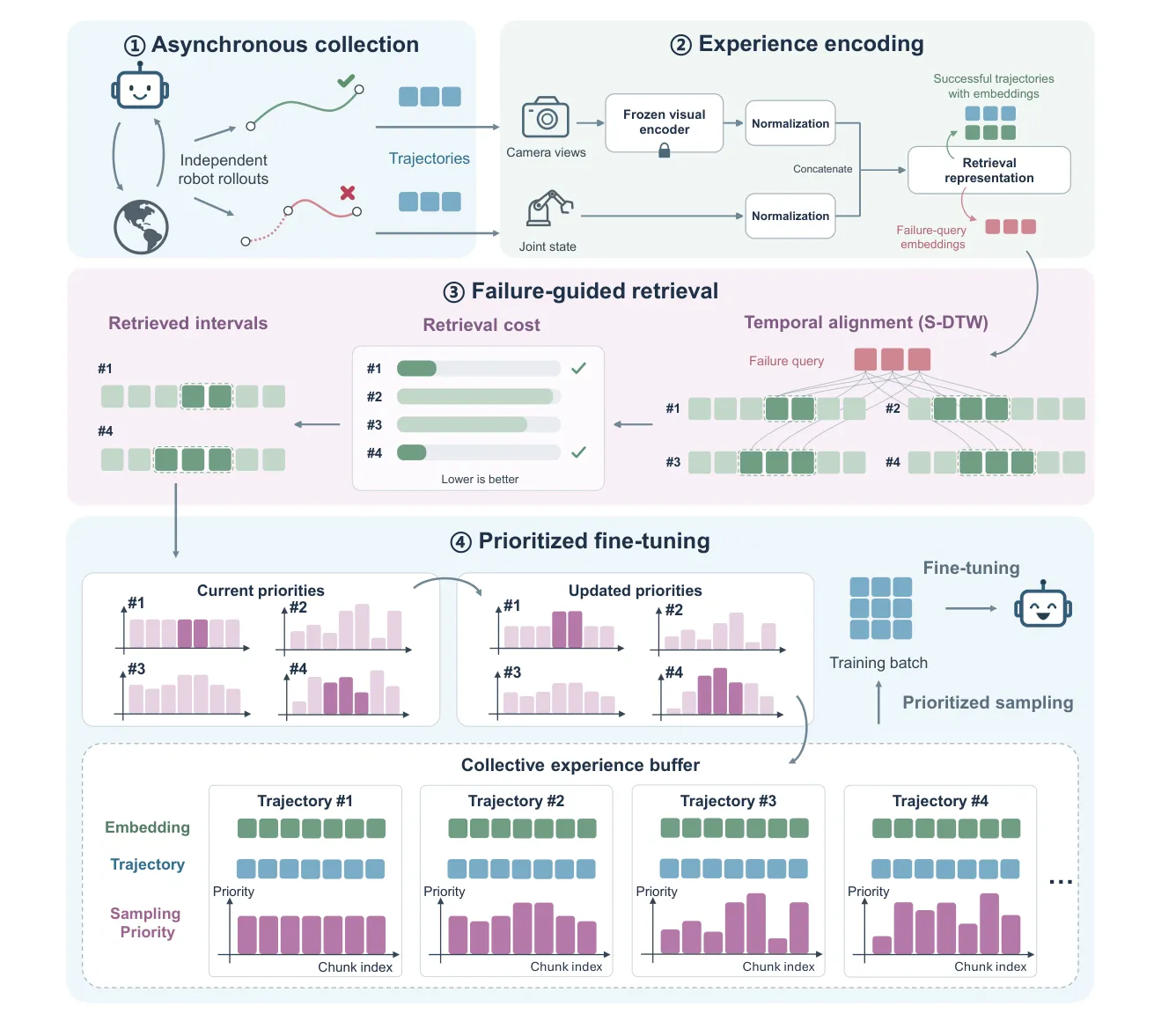
Full pipeline diagram showing collection, encoding, retrieval, and prioritized fine-tuning method stages

What it is

Robots improve a shared manipulation policy from fleet execution logs by retrieving successful peer trajectories near failure contexts, avoiding new expert corrections. Instead of relying on teleoperated corrections, failed executions query a shared buffer of successful fleet trajectories; retrieved segments are upweighted as supervision to fine-tune one shared policy asynchronously.

Key results

  • Phone packaging: 79.2% to 98.3% success with 96 robots
  • Across 5 tasks: 93.3-99.2% success over 120 eval trials per task
  • Removing failure-guided retrieval drops phone packaging from 86.7% to 64.2%

Shared autonomous experience can materially improve deployed robot reliability without scaling expert corrective supervision.

One useful ML email a week.

Worth your time, not all of your time.

We track new ML work across papers, code, and data, then keep only the pieces worth a closer look. Selected, not collected.

Papers.Data.Code

The Weekly ML Signal

Selected, not collected.

One useful ML email a week: the papers, repos and datasets worth your attention.

Worth your time, not all of your time.