Paper

Iris: Climbing to the Search Frontier

Hard web-graph-derived search tasks plus iterative SFT-RL climbing train a single ReAct search agent, without sub-agents or test-time verification.

arXiv ↗Sep 3, 2026Code ↗

  • llm
  • tool use
  • reinforcement learning
  • web search
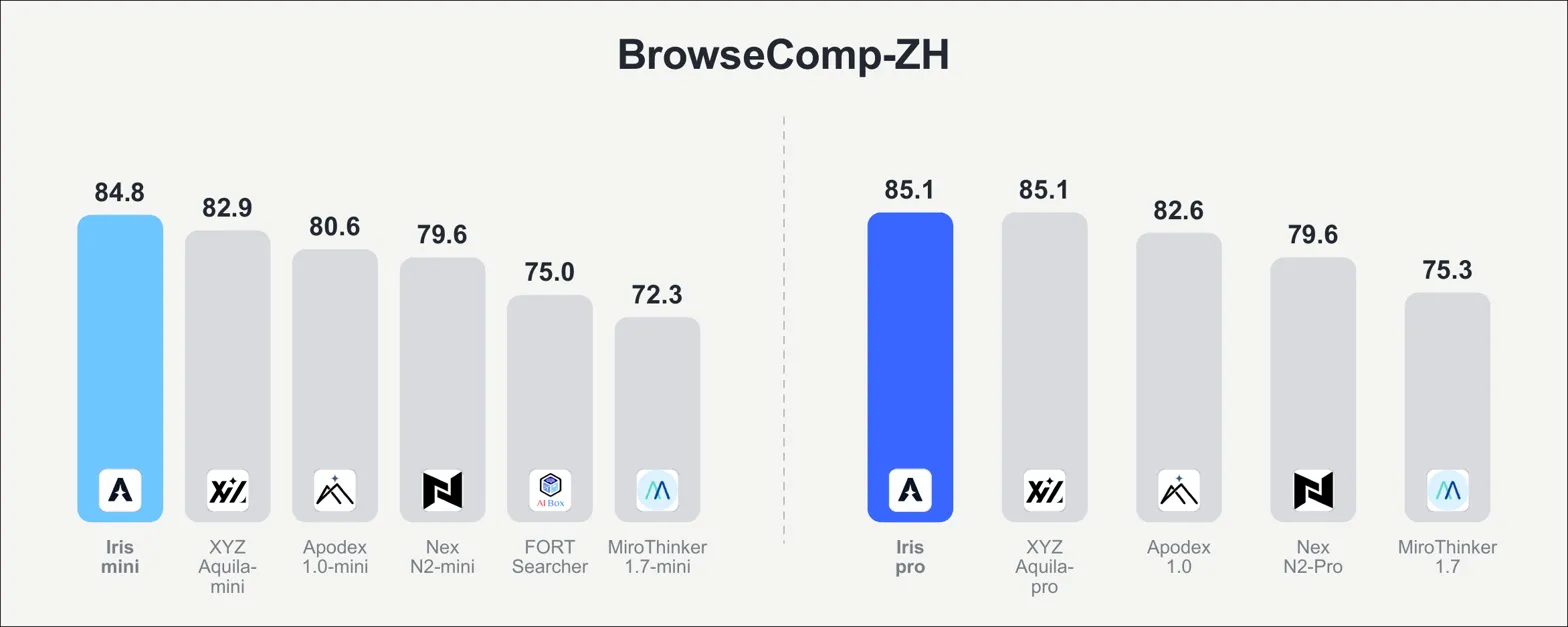
Bar chart comparing Iris models vs baselines on BrowseComp-ZH benchmark

What it is

Open-source web search agents trained with synthetic multi-hop tasks and iterative SFT-RL climbing. They target stronger long-horizon search with a single ReAct agent. Instead of relying on easier natural questions or test-time multi-agent tricks, it builds hard multi-hop search tasks from web links, filters trajectories at trajectory and turn level, then alternates SFT with live-search RL by feeding solved efficient rollouts back into training.

Key results

  • Iris-pro: 88.6 on BrowseComp, +3.8 over XYZ-Aquila-pro
  • Iris-pro: 56.4 on HLE, +3.1 over XYZ-Aquila-pro
  • Iris-mini: 82.2 on BrowseComp, +3.4 over XYZ-Aquila-mini

Careful task construction and alternating SFT with live-search RL can make single-agent open models highly competitive on long-horizon search.

One useful ML email a week.

Worth your time, not all of your time.

We track new ML work across papers, code, and data, then keep only the pieces worth a closer look. Selected, not collected.

Papers.Data.Code

The Weekly ML Signal

Selected, not collected.

One useful ML email a week: the papers, repos and datasets worth your attention.

Worth your time, not all of your time.