Paper

Grounded Action Model: 3D Grounding as a Foundation for Robotics

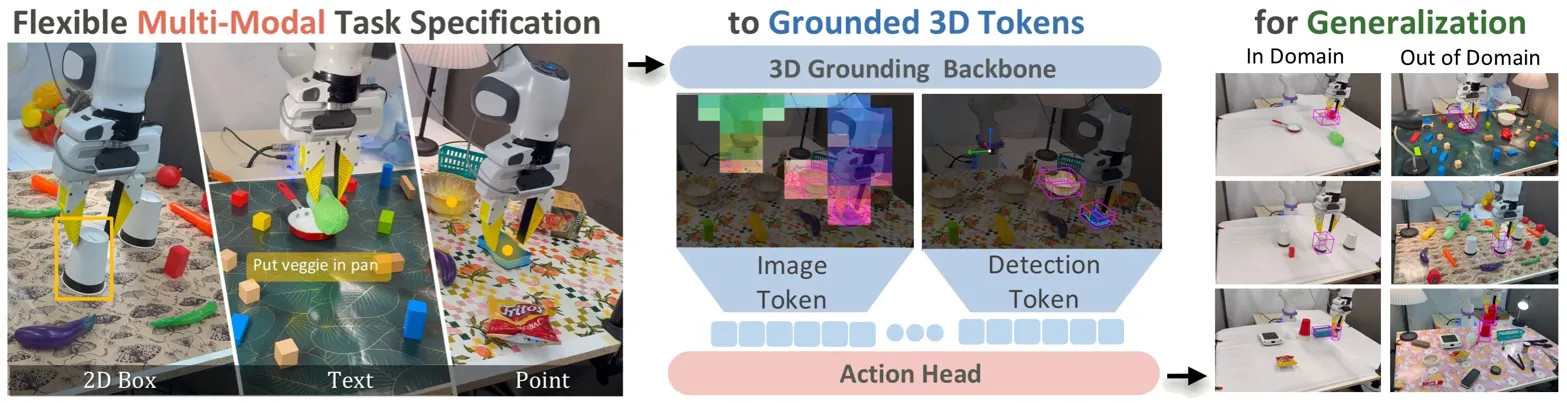
A grounded-control policy that replaces implicit scene understanding with explicit 3D object grounding from language, points, or boxes, then predicts action chunks.

arXiv ↗Sep 20, 2026Code ↗

  • robotics
  • manipulation
  • 3d grounding
  • imitation learning
Pipeline diagram showing multi-modal task specification to 3D tokens to action head

What it is

Builds robot policies on a frozen promptable 3D grounding model, turning language/point/box prompts into object-centric visual+metric inputs for action prediction. Instead of relying on VLA/WAM backbones to learn grounding from demos, it uses a frozen 3D grounding model to explicitly localize task objects and feed object-centric visual features plus 3D geometry into the action policy.

Key results

  • RoboTwin 2.0: 55.3% avg over 50 tasks vs 52.0% Spatial Forcing
  • LIBERO-PRO: 61% avg over 16 perturbations vs 53% for π0.5
  • Real YAM visual shift: 17/20 successes vs 4/20 for π0.5

Explicit object-centric 3D grounding improves manipulation robustness when targets move, are re-designated, or scenes shift visually.

One useful ML email a week.

Worth your time, not all of your time.

We track new ML work across papers, code, and data, then keep only the pieces worth a closer look. Selected, not collected.

Papers.Data.Code

The Weekly ML Signal

Selected, not collected.

One useful ML email a week: the papers, repos and datasets worth your attention.

Worth your time, not all of your time.