Paper

Does Learning Protein Folding Generalize to Broader Reasoning?

Uses protein-derived structural QA and shared 3D geometry supervision to post-train an LLM, then keeps only the adapted base model for general reasoning.

arXiv ↗Sep 30, 2026Code ↗

  • llm
  • reasoning
  • post-training
  • protein structure
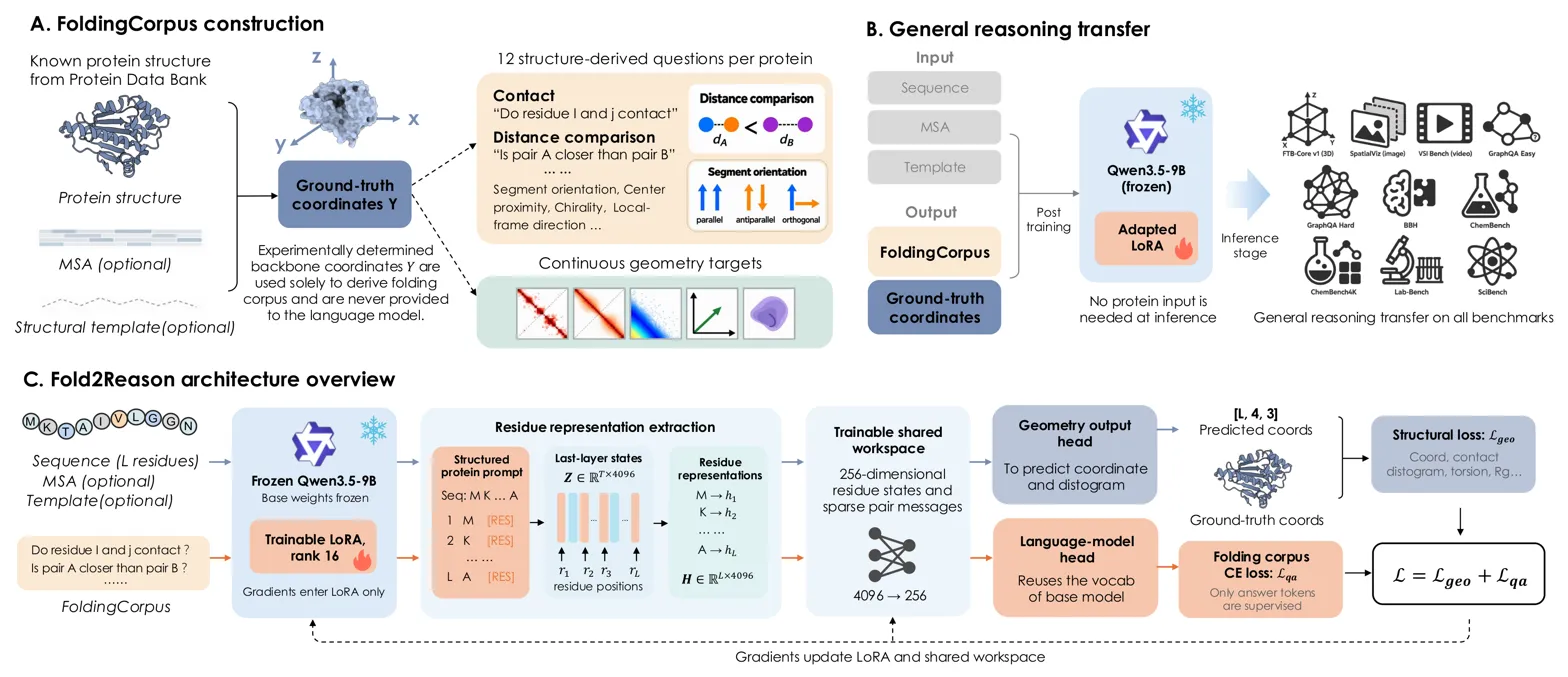
Full pipeline diagram showing corpus construction, architecture, and reasoning transfer method

What it is

Post-trains an LLM on protein-structure QA plus 3D geometry supervision to test whether folding signals transfer to broader reasoning. It improves protein folding and all 10 downstream reasoning benchmarks. Instead of training only on text or synthetic logic, it uses solved protein structures as exactly checkable supervision: LM-head answers to structural QA plus shared-state 3D geometry decoding, then discards protein-specific modules at inference.

Key results

  • General-10 macro 48.33% vs 45.09% base (+3.23 pp)
  • Positive gains on all 10 benchmarks; External9 improves by +3.14 pp
  • FoldBench structure scores are 2.7-3.5x Qwen3.5-9B

Structure-dense scientific supervision can transfer beyond its domain and improve broad reasoning without keeping task-specific modules at inference.

One useful ML email a week.

Worth your time, not all of your time.

We track new ML work across papers, code, and data, then keep only the pieces worth a closer look. Selected, not collected.

Papers.Data.Code

The Weekly ML Signal

Selected, not collected.

One useful ML email a week: the papers, repos and datasets worth your attention.

Worth your time, not all of your time.