Paper

Optimizing the Optimizer: Language Models Discover Faster Molecular Relaxation

An LLM-driven program search rewrites a geometry optimizer, accepting only edits that cut force calls and preserve energy recovery on held-out molecules.

arXiv ↗Oct 5, 2026Code ↗

  • geometry optimization
  • quantum chemistry
  • llm agents
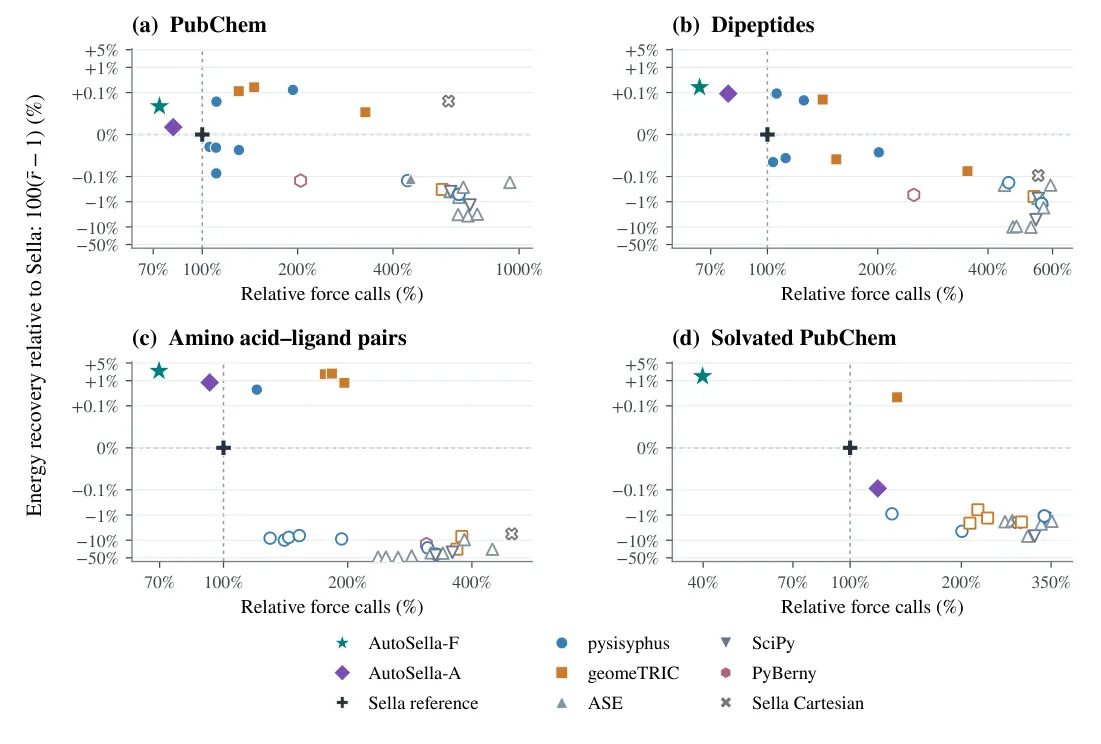
Core comparison of method vs baselines across benchmarks: energy recovery vs force calls

What it is

An LLM agent rewrites a molecular geometry optimizer and discovers AutoSella, which cuts force evaluations while preserving relaxation quality across unseen molecules and potentials. Instead of tuning hyperparameters or models, an LLM edits the optimizer code itself. A gated autoresearch loop keeps only changes that reduce force calls without shallower minima and that generalize to unseen molecules.

Key results

  • r2SCAN-3c: AutoSella-F uses 40.24% of Sella on Solvated PubChem
  • GFN2-xTB: AutoSella-F uses 39.86-73.25% of Sella across 4 test sets
  • GFN-FF: AutoSella-F uses 34.08-74.14% of Sella across 4 test sets

Optimizer code can be improved by LLM-guided search in ways that transfer from cheap surrogate potentials to DFT.

One useful ML email a week.

Worth your time, not all of your time.

We track new ML work across papers, code, and data, then keep only the pieces worth a closer look. Selected, not collected.

Papers.Data.Code

The Weekly ML Signal

Selected, not collected.

One useful ML email a week: the papers, repos and datasets worth your attention.

Worth your time, not all of your time.