Paper

ALoDLM: Adaptively Looped Diffusion Language Models

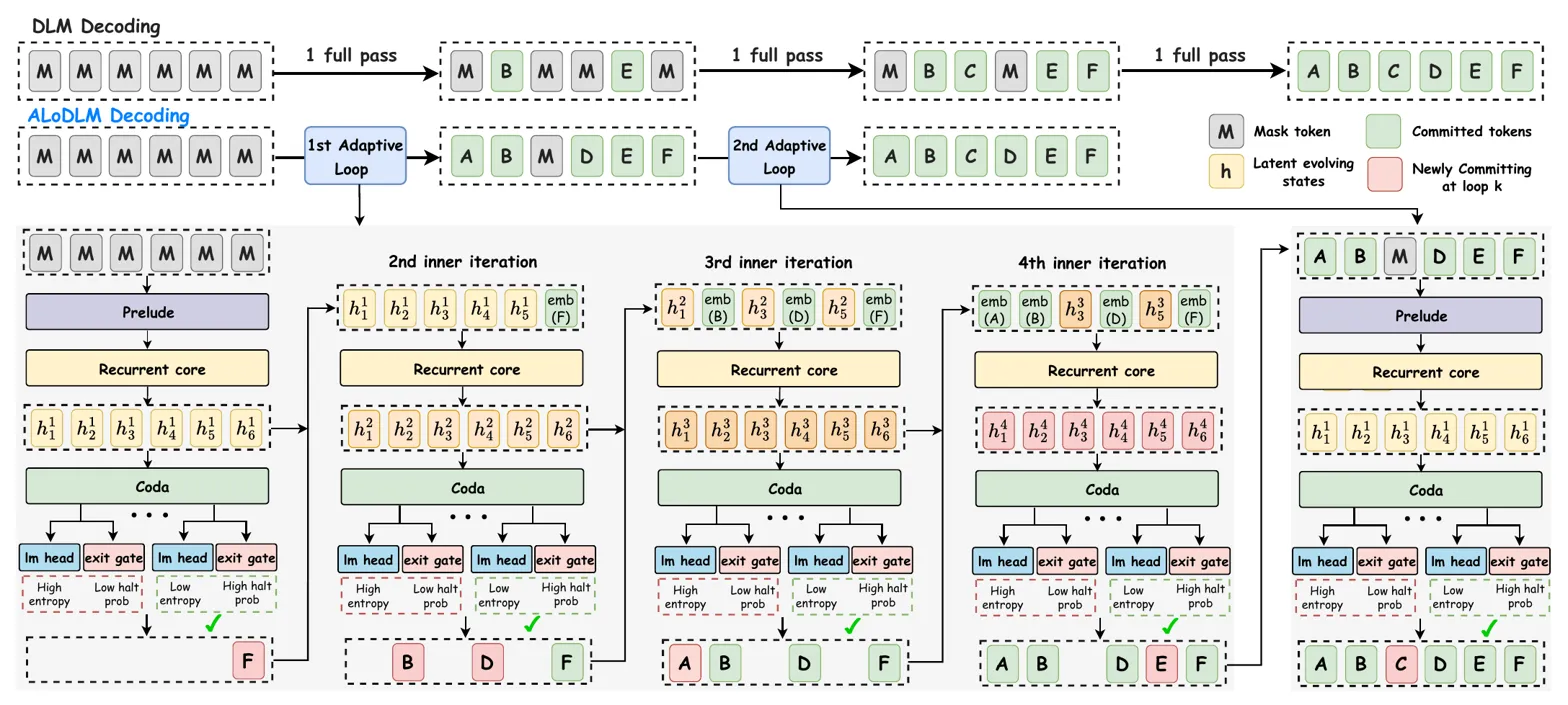
Token-adaptive recurrence replaces fixed denoising depth in DLMs. Easy tokens exit early as discrete context; hard ones keep refining latent states within each step.

arXiv ↗Oct 3, 2026Code ↗

  • llm
  • diffusion language models
  • adaptive computation
  • parallel decoding
Detailed method/pipeline diagram comparing DLM vs ALoDLM decoding with adaptive loops

What it is

A diffusion LM that adaptively gives harder tokens more inner-loop compute while committing easy ones early. It closes the quality gap to AR models without losing parallel decoding speed. Instead of uniform denoising depth for all masked tokens, it uses token-adaptive latent recurrence: easy tokens commit early as context, hard tokens keep refining persistent latent states. It jointly learns token prediction and per-token compute schedules via a latent-variable NELBO.

Key results

  • 80.3 average over 11 benchmarks at 8B, above Qwen3-8B's 78.5
  • 65.5 average at 1.7B, above Qwen3-1.7B's 63.8
  • ~2.7x Qwen3-8B throughput on GSM8K at comparable or higher accuracy

Shows that matching per-token compute to prediction difficulty can make diffusion LMs both stronger than comparable AR baselines and still faster to decode.

One useful ML email a week.

Worth your time, not all of your time.

We track new ML work across papers, code, and data, then keep only the pieces worth a closer look. Selected, not collected.

Papers.Data.Code

The Weekly ML Signal

Selected, not collected.

One useful ML email a week: the papers, repos and datasets worth your attention.

Worth your time, not all of your time.