Paper

Dual Latent Memory in Vision-Language-Action Models for Robotic Manipulation

History is used as native latent tokens, not auxiliary memory. It retrieves short- and long-term evidence, condenses it, and inserts it before action generation.

arXiv ↗Jul 8, 2026Code ↗

  • robotics
  • cv
  • vision-language-action
  • robot manipulation
  • memory models
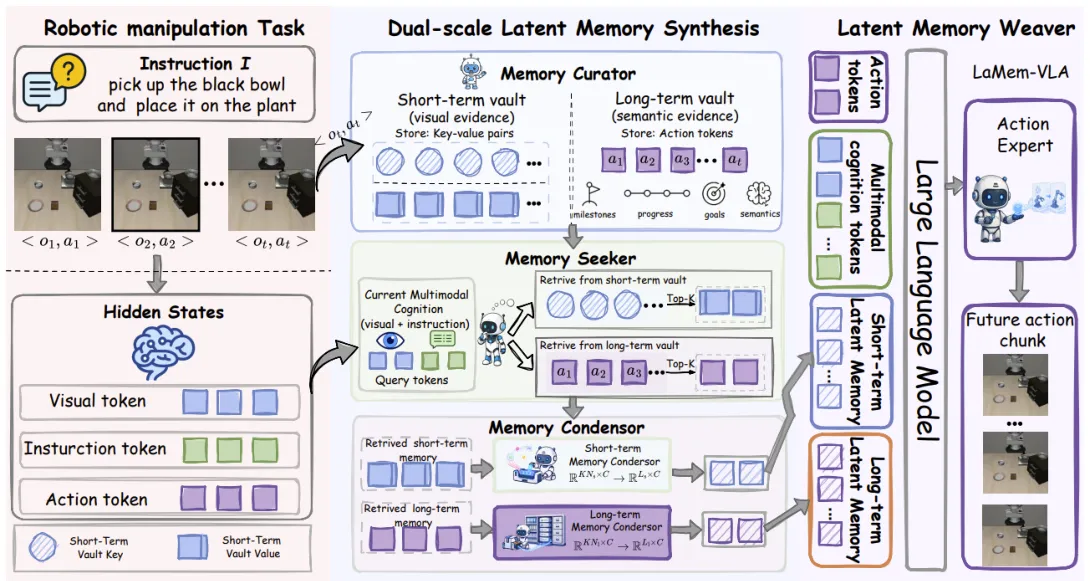
Full pipeline diagram showing LaMem-VLA memory synthesis architecture and components

What it is

A VLA for robotic manipulation that turns history into latent memory tokens and injects short- and long-term memory directly into action reasoning. Instead of using history as external context or longer frame windows, it reconstructs retrieved short-term visual and long-term action history into latent tokens woven into the VLA token stream.

Key results

  • 97.6% avg success on LIBERO, +1.1 over MemoryVLA, +4.4 over CogACT
  • 73.9% avg success on SimplerEnv-Bridge, +16.6 over CogACT
  • Beats π0 by 3.5 pts on the first four LIBERO suites and by 4.7 on SimplerEnv

Shows that making memory part of the VLA latent reasoning stream is more effective than policy-side memory conditioning for long-horizon manipulation.

One useful ML email a week.

Worth your time, not all of your time.

We track new ML work across papers, code, and data, then keep only the pieces worth a closer look. Selected, not collected.

Papers.Data.Code

The Weekly ML Signal

Selected, not collected.

One useful ML email a week: the papers, repos and datasets worth your attention.

Worth your time, not all of your time.