Paper

Wave Forcing: Towards Speed-of-Light Streaming Video Generation

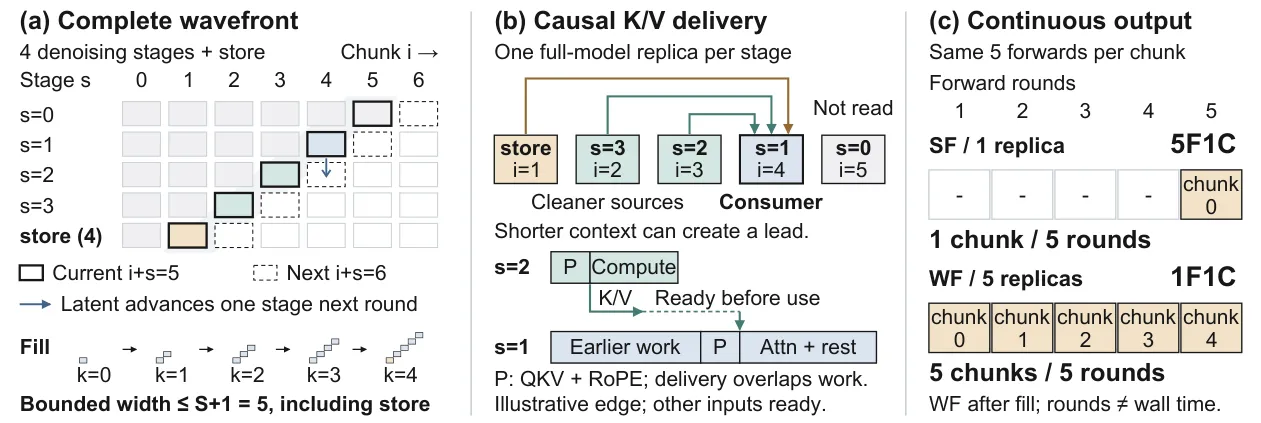
Pipelines chunk denoising and history refresh across replicas, using causal access to cleaner in-flight chunks to sustain continuous video output.

arXiv ↗Oct 31, 2026Code ↗

  • cv
  • video generation
  • diffusion models
  • systems for ml
Method diagram showing wavefront denoising, causal K/V delivery, and continuous output pipeline

What it is

A streaming video generation system that pipelines chunk denoising and cache refresh to emit one chunk per forward round after fill, while preserving long-video quality and motion. Instead of serial chunk denoising plus a separate cache-refresh pass, it lets newer chunks attend to earlier cleaner-but-unfinished chunks and pipelines denoise/store across model replicas for 1F1C continuous output.

Key results

  • 134.8 end-to-end FPS and 147.6 DiT FPS on 8 H200s with 4-step WF
  • 5-step WF: 81.64 VBench Total vs 81.15 for Rolling Forcing
  • Long-video Dynamic 91.45 vs 36.63 for Rolling Forcing; Subject 97.10 vs 92.75

Shows streaming video generation can reach near-real-time throughput without giving up long-horizon motion or subject consistency.

One useful ML email a week.

Worth your time, not all of your time.

We track new ML work across papers, code, and data, then keep only the pieces worth a closer look. Selected, not collected.

Papers.Data.Code

The Weekly ML Signal

Selected, not collected.

One useful ML email a week: the papers, repos and datasets worth your attention.

Worth your time, not all of your time.