Paper

What Makes World Action Models Generalize? An Empirical Study of Test-Time Future Modeling

Keeps future conditioning but skips iterative video generation: one video-model pass over fully noised future tokens conditions all action steps.

arXiv ↗Sep 29, 2026Code ↗

  • cv
  • robotics
  • imitation learning
  • world models
  • policy generalization
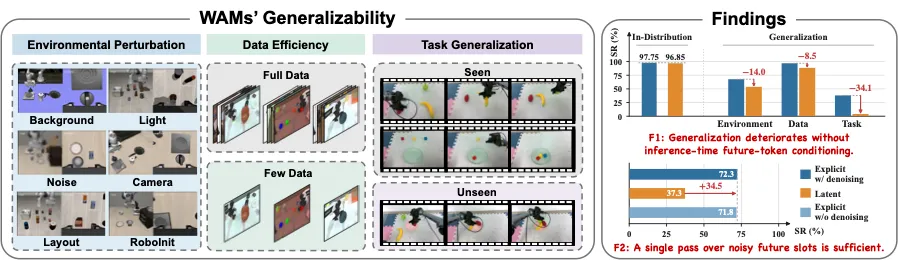
Shows generalizability categories and key findings with comparative SR bar charts

What it is

Studies why world action models generalize and shows test-time future conditioning matters. It proposes Simple-WAM: one pass over fully noised future tokens instead of iterative video denoising. Instead of either fully denoising future video at test time or dropping it entirely, keep future-token conditioning but use a single pass on fully noised future tokens. This isolates that preparing future representations, not generating clean frames, drives WAM generalization.

Key results

  • 79.5 perturbation success vs 67.7 explicit and 53.8 latent
  • 3.8× faster than explicit WAM, with only 1.2× latent latency
  • Explicit beats latent on task gen w/ video: 69.9 vs 5.9 success

Inference-time access to future-token representations, not clean future-frame generation, is what preserves WAM generalization.

One useful ML email a week.

Worth your time, not all of your time.

We track new ML work across papers, code, and data, then keep only the pieces worth a closer look. Selected, not collected.

Papers.Data.Code

The Weekly ML Signal

Selected, not collected.

One useful ML email a week: the papers, repos and datasets worth your attention.

Worth your time, not all of your time.