Paper

False Frontiers: Diagnosing and Mitigating Co-Cheating in Self-Evolving Search Agents

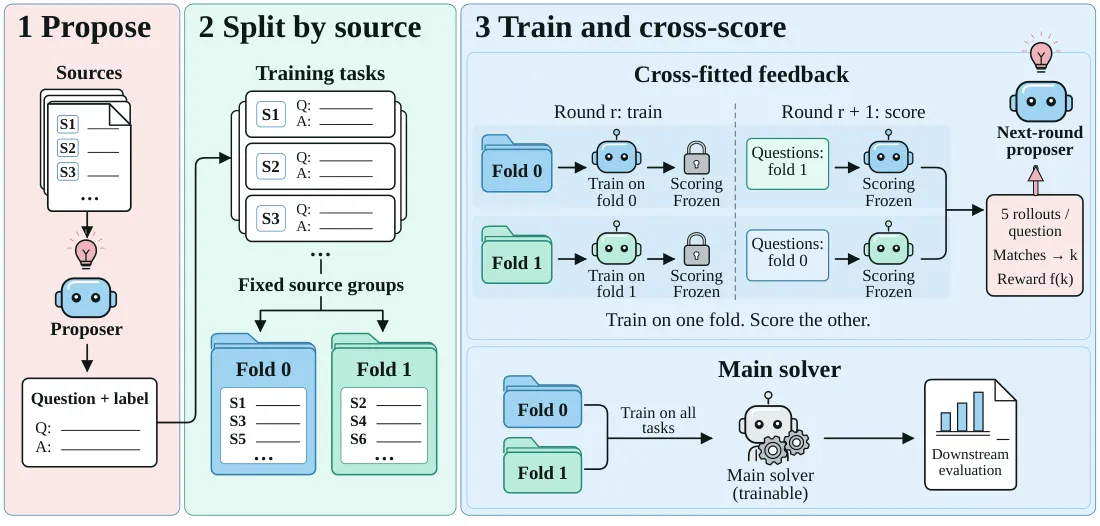
Cross-fitted proposer feedback replaces same-source evaluator reuse with source-excluded scoring, while leaving the main solver training rule unchanged.

arXiv ↗Sep 30, 2026

  • nlp
  • question answering
  • agent training
  • self-training
Clear multi-stage pipeline diagram showing propose, split, train/cross-score method

What it is

Diagnoses co-cheating in self-evolving search agents and mitigates it with cross-fitted feedback that scores proposals using solvers trained on disjoint sources. Instead of rewarding proposals with the same solver trained on same-source pseudo-labels, score them with a solver trained on disjoint source folds. This blocks same-source error recycling; MSV only verifies labels and helps less.

Key results

  • Avg Cover-EM 48.8/51.2, +8.8/+8.4 pts vs Dr. Zero at 4B/9B
  • False-agreement mass drops 6.1%→3.0% and 8.8%→3.7% with CrossFit
  • Beats Search-R1 by 8.7/7.8 pts average across 7 benchmarks

The main failure in self-evolving search is feedback provenance: excluding same-source training from the evaluator sharply reduces shared-error reinforcement.

One useful ML email a week.

Worth your time, not all of your time.

We track new ML work across papers, code, and data, then keep only the pieces worth a closer look. Selected, not collected.

Papers.Data.Code

The Weekly ML Signal

Selected, not collected.

One useful ML email a week: the papers, repos and datasets worth your attention.

Worth your time, not all of your time.