Paper

FuseReg: Regularizing Layer Fusion Mitigates the Reconstruction-Generation Gap in Representation Autoencoders

Rather than commit RAEs to one fixed layer fusion, it trains decoder and DiT on random normalized layer subsets to make latent fusion robust.

arXiv ↗Sep 25, 2026Code ↗

  • cv
  • image generation
  • diffusion models
  • autoencoders
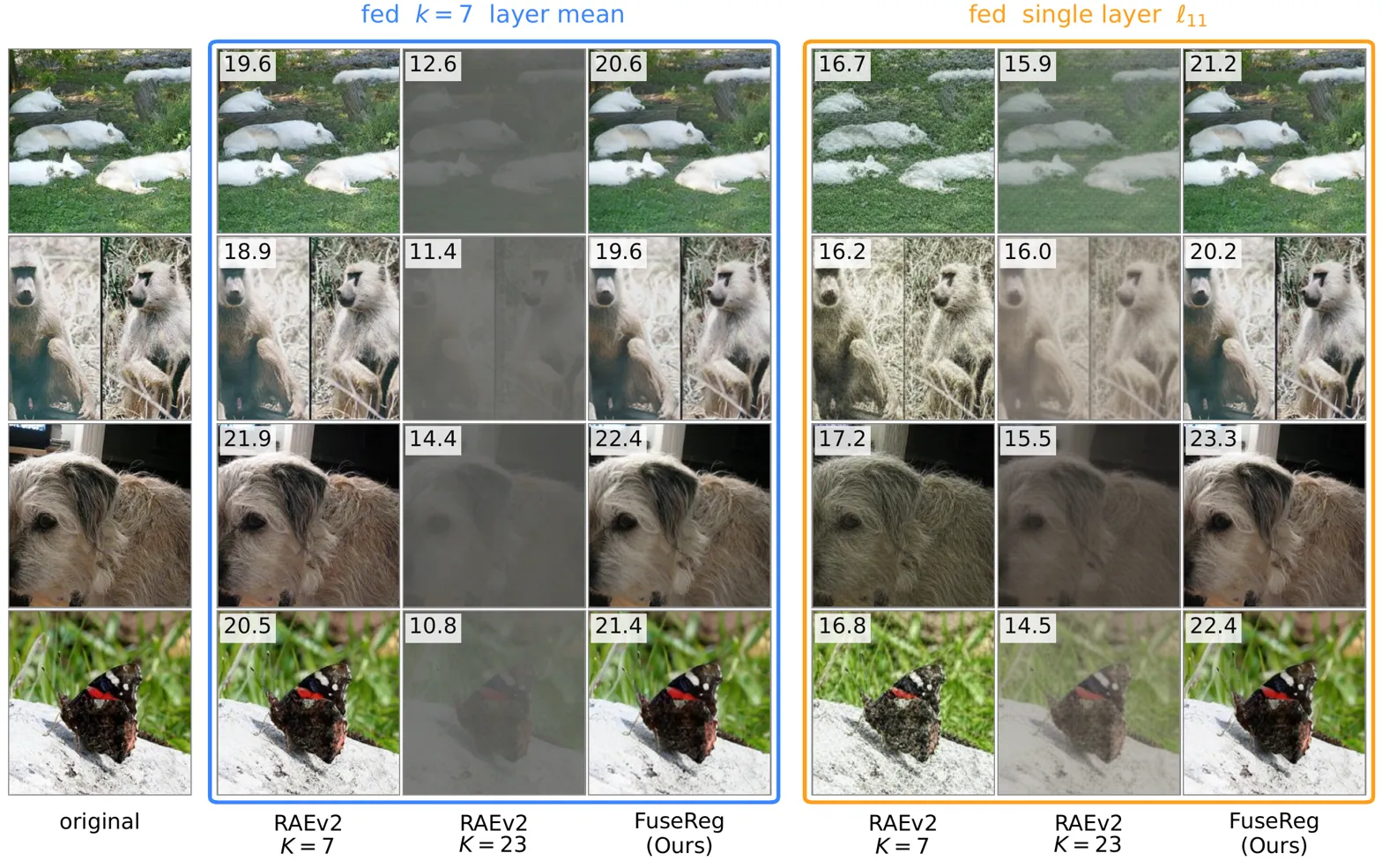
Comparative grid: method vs baselines with PSNR scores across multiple images showing superiority

What it is

Regularizes RAEs by training decoder and DiT on random encoder-layer subsets instead of one fixed fusion, improving robustness and narrowing the reconstruction-generation trade-off. Instead of picking one heuristic or gated layer fusion, train decoder and generator on random normalized subsets of encoder layers. This makes them robust to cross-layer disagreement and supports full, sparse, or single-layer latents without changing the pretrained encoder.

Key results

  • Unguided gFID drops 3.01→2.21 by replacing only the decoder
  • Joint FuseReg cuts DiT-Base unguided gFID 13.96→9.93
  • One decoder gets 27.52 dB PSNR on k=23 and 25.13 dB on single-layer l11

Training downstream RAE components for layer-fusion robustness reduces the mismatch between reconstruction-friendly and generation-friendly latents.

One useful ML email a week.

Worth your time, not all of your time.

We track new ML work across papers, code, and data, then keep only the pieces worth a closer look. Selected, not collected.

Papers.Data.Code

The Weekly ML Signal

Selected, not collected.

One useful ML email a week: the papers, repos and datasets worth your attention.

Worth your time, not all of your time.