Paper

CUA-Master: Scaling Computer-use Agents through Open-World Recursive Improvements

Open-world video workflows become seed tasks, then reusable primitives synthesize controllable GUI/CLI tasks with rollback-based data collection.

arXiv ↗Nov 2, 2026Code ↗

  • llm
  • multimodal
  • agents
  • gui automation
  • synthetic data
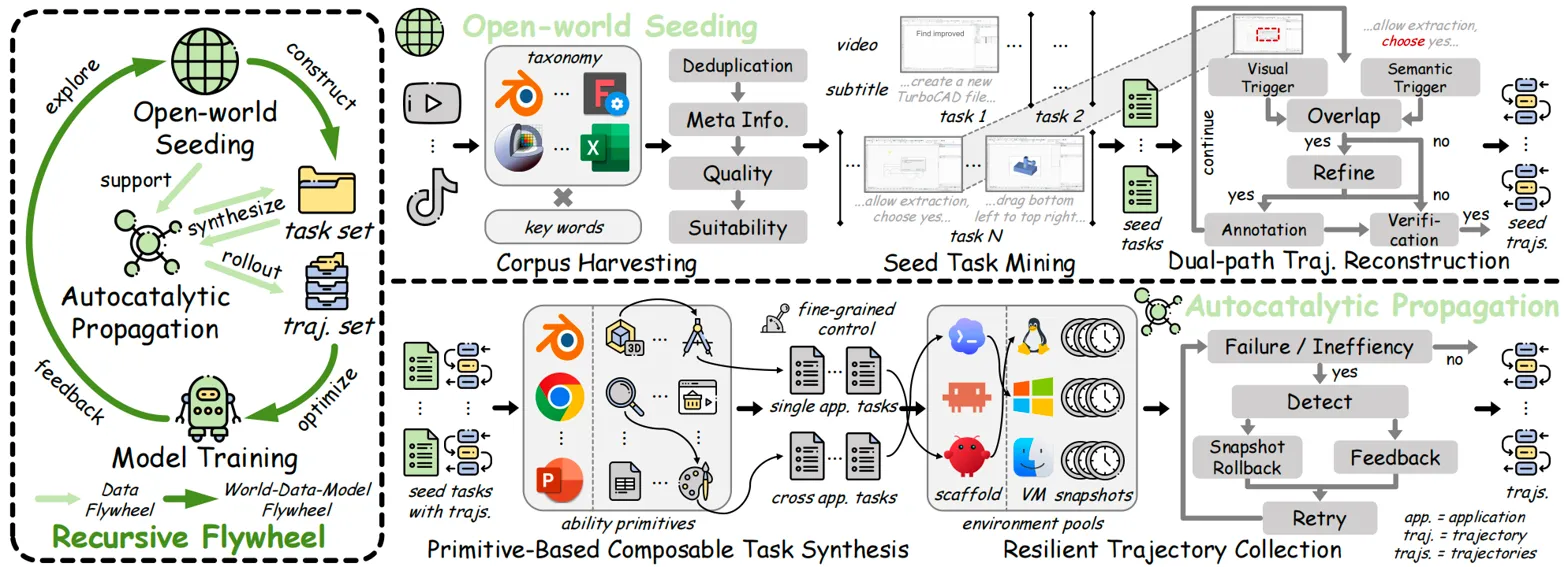
Detailed pipeline diagram showing the recursive flywheel method and components

What it is

A recursive training framework for computer-use agents that mines real workflows from open-world videos, turns them into controllable task primitives, and iteratively improves data and models. Instead of closed-loop self-improvement on self-generated traces, it uses a double flywheel: open-world video mining for real seed workflows, then primitive-based synthesis plus rollback-assisted rollout to build diverse, verifiable GUI/CLI training data.

Key results

  • 80.2 avg on OSWorld Verified, competitive with top closed-source agents
  • 43.9 avg on WeaveBench, above UI-Mate-27B's 18.3
  • 25.0 full-pass on Agents' Last Exam, above Qwen-CUA's 5.3

Shows open-world seeded, recursively targeted data generation scales computer-use agents better than closed self-improvement alone.

One useful ML email a week.

Worth your time, not all of your time.

We track new ML work across papers, code, and data, then keep only the pieces worth a closer look. Selected, not collected.

Papers.Data.Code

The Weekly ML Signal

Selected, not collected.

One useful ML email a week: the papers, repos and datasets worth your attention.

Worth your time, not all of your time.