Paper

CoWindow Attention: Full Causal Coverage Is a Collective Property

A head-partitioned sparse attention scheme: all heads keep local/prefix access, while distant context is split across KV heads to preserve full coverage collectively.

arXiv ↗Sep 26, 2026

  • llm
  • sparse attention
  • long-context
  • transformers
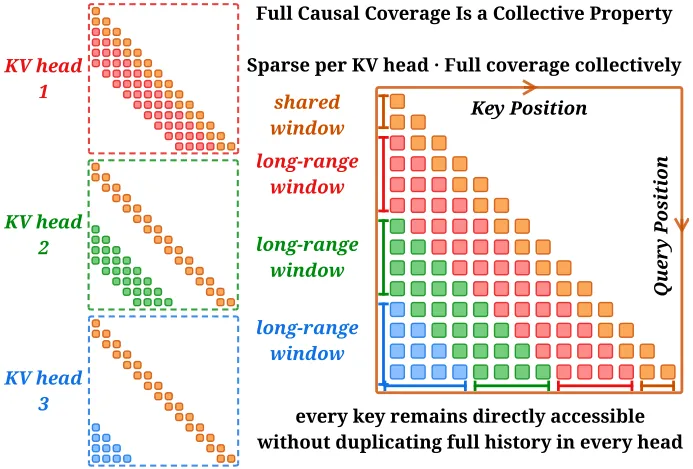
Method diagram illustrating sparse per-head attention achieving full causal coverage collectively

What it is

Structured sparse attention splits long-range causal history across KV heads while keeping full coverage collectively. It preserves model quality near full attention with much lower long-context cost. Instead of giving every head the full prefix, CoWA shares local and sink windows across heads and partitions distant history into complementary head-specific windows. This keeps full causal coverage collectively, with a fixed position-based pattern and no router.

Key results

  • 128K: 7.4x/8.6x lower train fwd/bwd latency vs FullAttn
  • 128K decoding: 3.0x lower latency and 7.6x lower peak memory vs FullAttn
  • 8K recall: 89.73% vs 89.97% FullAttn; DSA 53.71%, MoBA 50.12%

Full causal access need not be duplicated per head; distributing long-range context across heads preserves quality while cutting attention cost.

One useful ML email a week.

Worth your time, not all of your time.

We track new ML work across papers, code, and data, then keep only the pieces worth a closer look. Selected, not collected.

Papers.Data.Code

The Weekly ML Signal

Selected, not collected.

One useful ML email a week: the papers, repos and datasets worth your attention.

Worth your time, not all of your time.