Paper

Three-Body Scattering for Generative Modeling

Uses per-sample real-attract/fake-repel scattering targets from energy distance, with optional online field tracking, to train one-step generators directly.

arXiv ↗Jul 20, 2026Code ↗

  • llm
  • cv
  • generative modeling
  • image generation
  • distribution matching
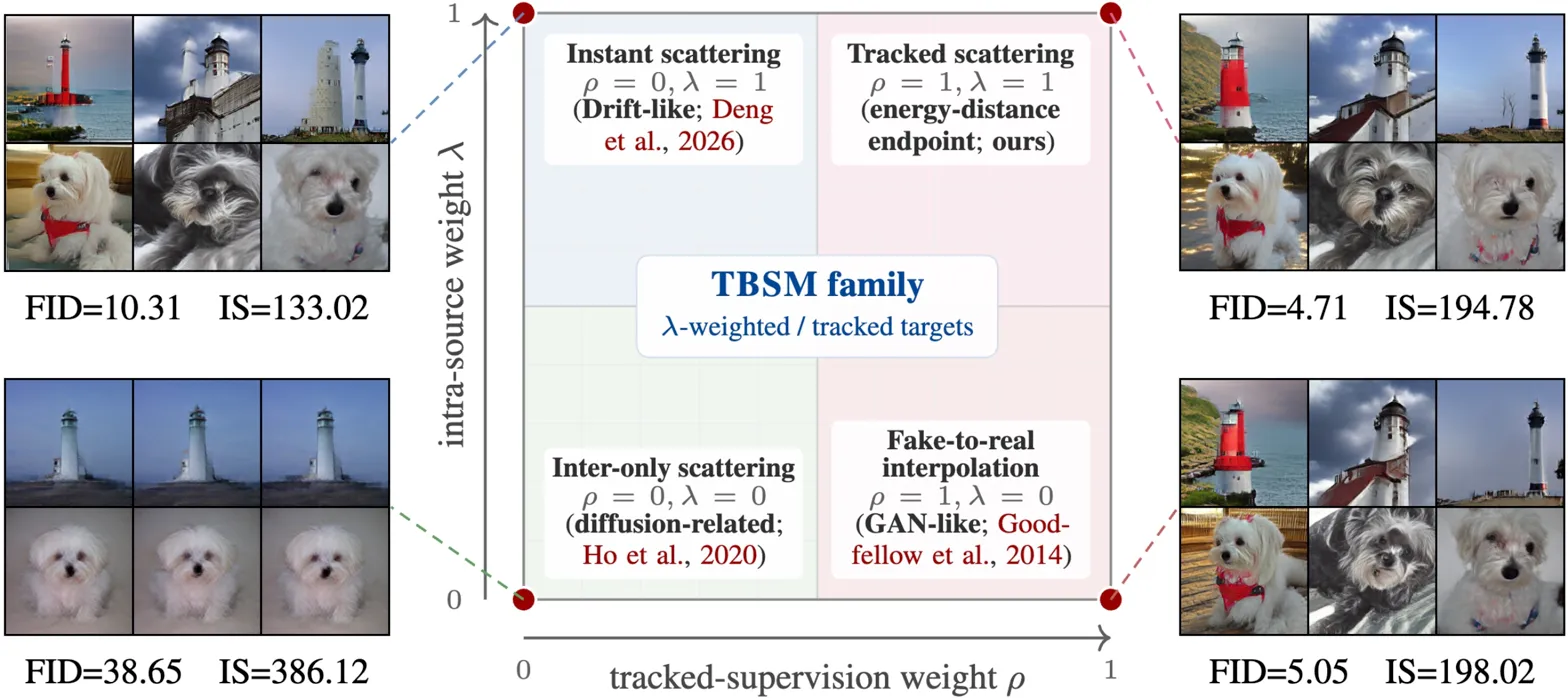
2D taxonomy of TBSM family with FID/IS comparisons and sample outputs across configurations

What it is

Trains one-step generators by regressing each sample toward a real-attract, fake-repel scattering target from energy distance, avoiding critics and diffusion teachers. Instead of minibatch all-pairs fields or teacher-guided paths, it uses constant-size triplets: each generated sample moves toward one real sample and away from one fake. An online tracker estimates the conditional mean scattering field to reduce noise.

Key results

  • ImageNet-256, NFE=1: FID 1.63 with latent-space DiT-XL
  • ImageNet-256, NFE=1: FID 2.23 with pixel-space PixelDiT-XL
  • ImageNet-512: DiT-XL/4 reaches FID 1.92 at NFE=1

Shows that energy-distance supervision can scale to high-dimensional one-step generation using only constant-size sample interactions.

One useful ML email a week.

Worth your time, not all of your time.

We track new ML work across papers, code, and data, then keep only the pieces worth a closer look. Selected, not collected.

Papers.Data.Code

The Weekly ML Signal

Selected, not collected.

One useful ML email a week: the papers, repos and datasets worth your attention.

Worth your time, not all of your time.