
What it is
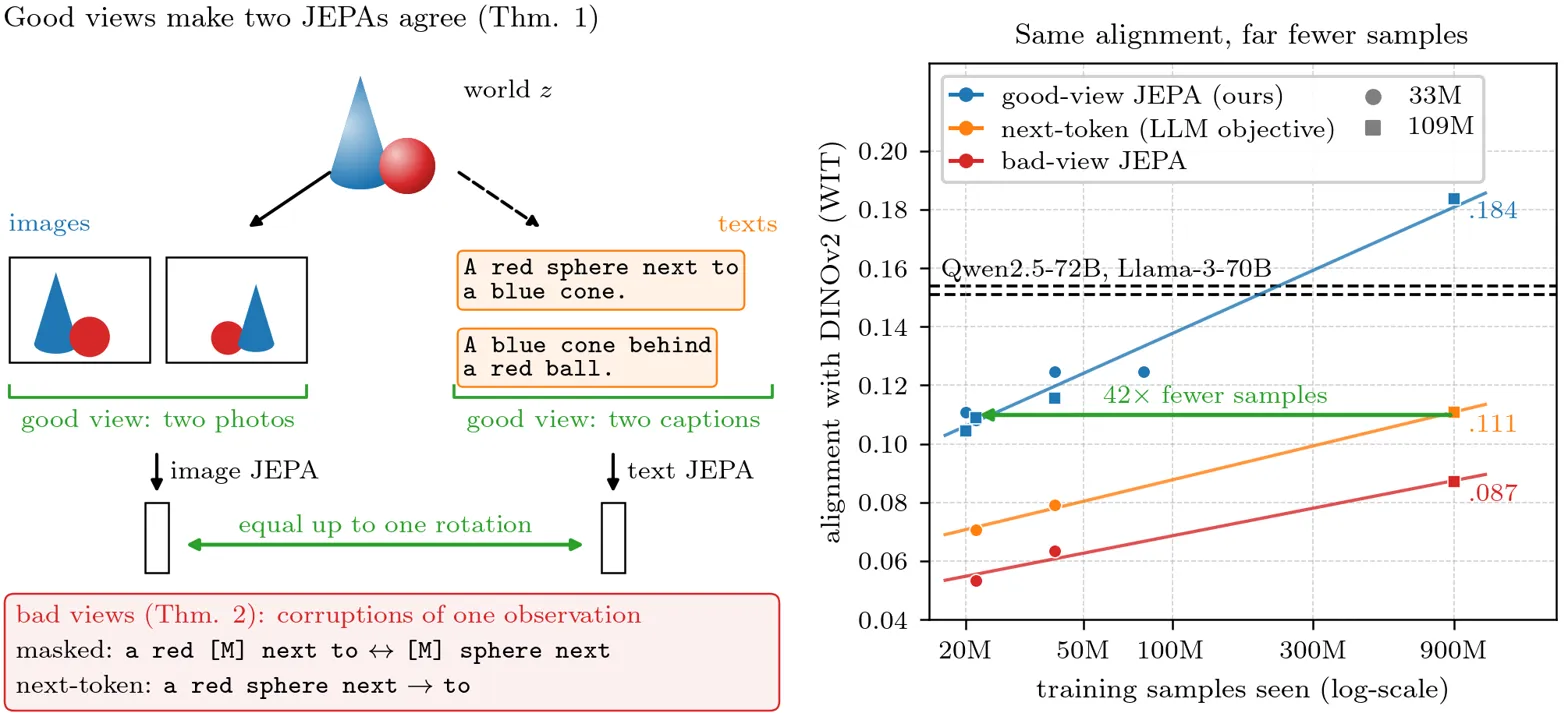
Proves that separately trained JEPAs align across modalities up to a rotation when positives are matched scene views, and shows this is far more efficient than next-token prediction. Instead of relying on scale to make language align with vision, use JEPA positives that are two views of the same scene; this yields a theorem that separately trained modality encoders share one representation up to rotation, while next-token prediction is framed as a bad-view JEPA.
Key results
- 109M text JEPA gets .184 vs Qwen2.5-72B .154 on DINOv2 alignment
- Matches next-token prediction with 21.6M vs 900M samples, 42x fewer
- Pair-free alignment hits 64% top-5 on ImageNet-100 vs prior LM best 56%
Cross-modal platonic representations depend mainly on the positive-view structure, not on scaling next-token prediction alone.