Paper

Memento 3: Model-Based Recursive Self-Improvement through Reflective Rulebooks

External rulebooks replace weight updates: the agent writes world rules in language, compiles them to code, and revises both from prediction errors under replay checks.

arXiv ↗Oct 8, 2026

  • llm
  • nlp
  • cv
  • world models
  • agentic planning
  • external memory
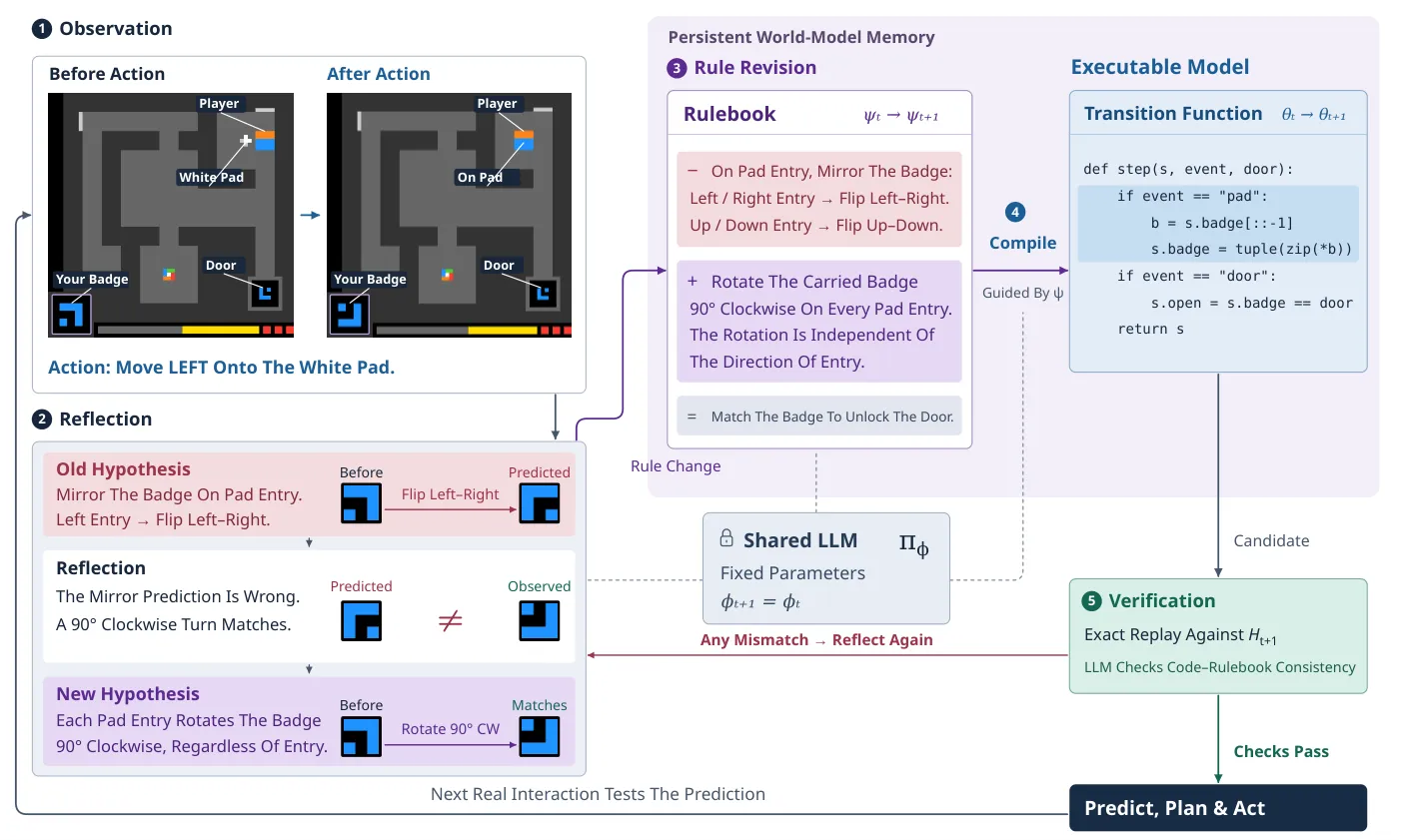
Full pipeline diagram showing observation, reflection, rule revision, compilation, verification loop

What it is

A frozen LLM agent learns and revises explicit world models as natural-language rulebooks plus executable code, then plans with the verified model to improve itself through interaction. Instead of updating model weights, it stores revisable environment rules in external memory and compiles them to code. Prediction errors trigger rulebook and code revision, with updates accepted only if code matches the rules and exactly replays observed transitions.

Key results

  • Clears every level of all 25 ARC-AGI-3 public games
  • 100.0 mean RHAE on ARC-AGI-3, +59.3 vs Claude Opus 5 harness
  • Atari Pong controller wins 21:0 in 3 episodes with no further LLM calls

Shows a frozen LLM can improve behavior by iteratively refining verified symbolic world models in external memory rather than updating parameters.

One useful ML email a week.

Worth your time, not all of your time.

We track new ML work across papers, code, and data, then keep only the pieces worth a closer look. Selected, not collected.

Papers.Data.Code

The Weekly ML Signal

Selected, not collected.

One useful ML email a week: the papers, repos and datasets worth your attention.

Worth your time, not all of your time.