Paper

FreeToken: Efficient Edge-Native MoE Serving with Bandwidth-Adaptive Execution

A bandwidth-adaptive MoE serving stack for edge devices that replaces fixed offloading with dynamic CPU/GPU expert execution and semantic prefix reuse.

arXiv ↗Aug 17, 2026Code ↗

  • llm
  • mixture of experts
  • inference serving
  • systems
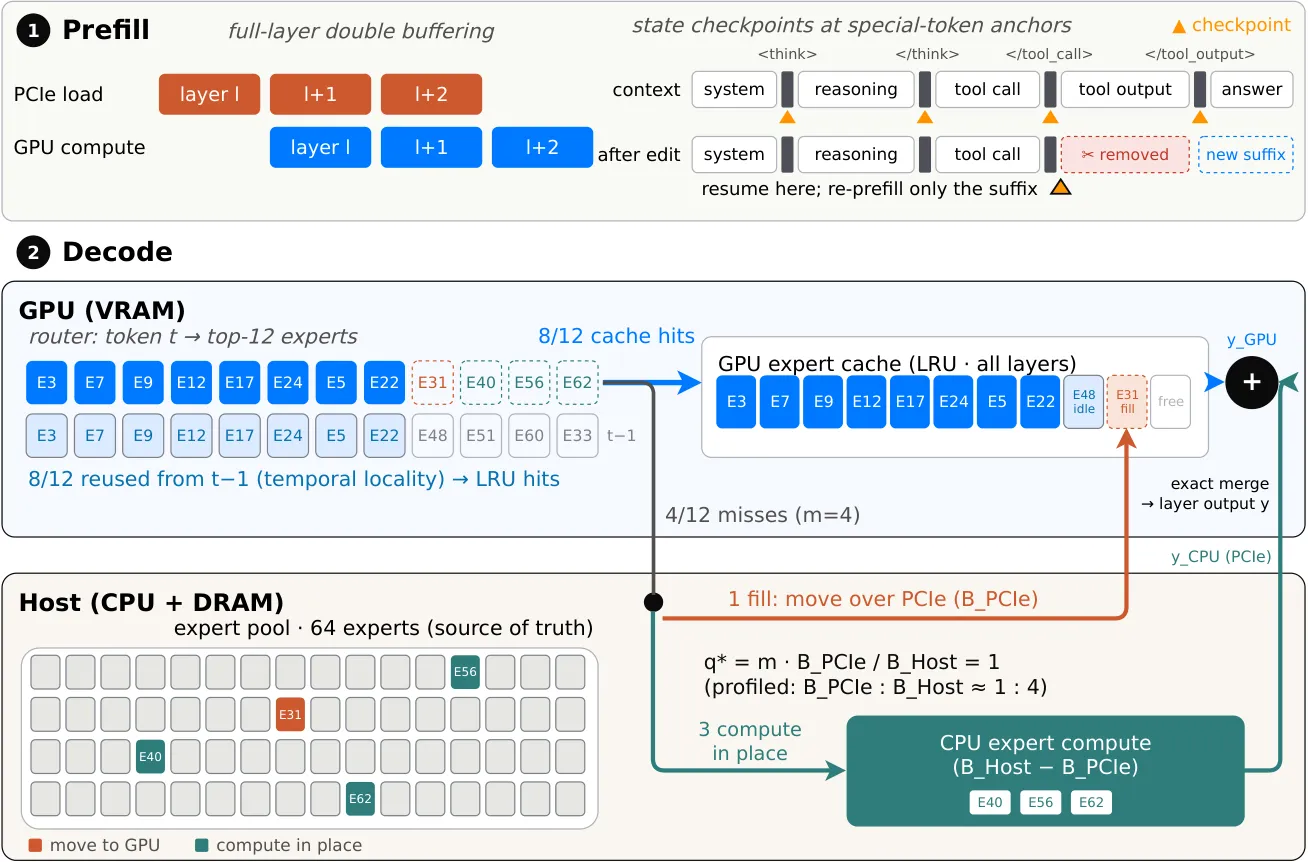
Detailed pipeline diagram showing prefill, decode, expert caching and CPU/GPU compute method

What it is

Edge-native MoE serving for local hardware that adapts expert placement and CPU/GPU execution to available bandwidth and memory. It makes frontier MoE models practical on laptops and desktops. Instead of fixed offloading or static expert placement, it continuously adapts MoE execution to machine bandwidth and memory: double-buffered prefill, semantic state reuse, shared expert cache, and a q* split of misses between GPU fills and CPU execution.

Key results

  • 1.5-2.3x higher decode throughput than edge baselines on RTX 5090
  • Worst-case TTFT stays under 44 s; every baseline exceeds 150 s somewhere
  • 39.3 tok/s for a 35B model on an 8GB RTX 4060 laptop, above Codex median 33

Edge MoE serving works much better when expert movement and execution are adapted online to hardware bandwidth and agent-style context edits.

One useful ML email a week.

Worth your time, not all of your time.

We track new ML work across papers, code, and data, then keep only the pieces worth a closer look. Selected, not collected.

Papers.Data.Code

The Weekly ML Signal

Selected, not collected.

One useful ML email a week: the papers, repos and datasets worth your attention.

Worth your time, not all of your time.