
What it is
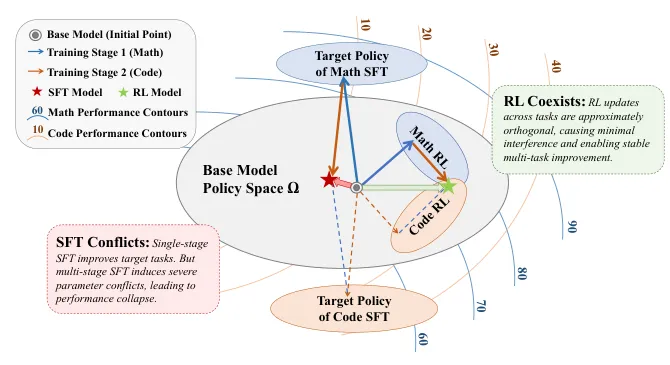
Analyzes why multi-task SFT causes task interference while RL remains stable in LLM reasoning, and proposes Parallel-RL to exploit RL's near-orthogonal task updates. Instead of mixing tasks to avoid forgetting, it shows RL updates across tasks are sparse and near-orthogonal while SFT updates conflict; this motivates Parallel-RL, which trains tasks independently and merges RL updates.
Key results
- Multi-stage RL gains 24.9% avg vs base; multi-stage SFT drops 23.1%
- Single-task RL improves untrained tasks by 2.3% avg; SFT hurts them by 5.1%
- RL task-update cosine similarity is ~1e-5 vs ~1e-1 to 1.0 for SFT
On-policy RL with advantage normalization naturally reduces cross-task gradient interference, making sequential multi-task training far more stable than SFT.