
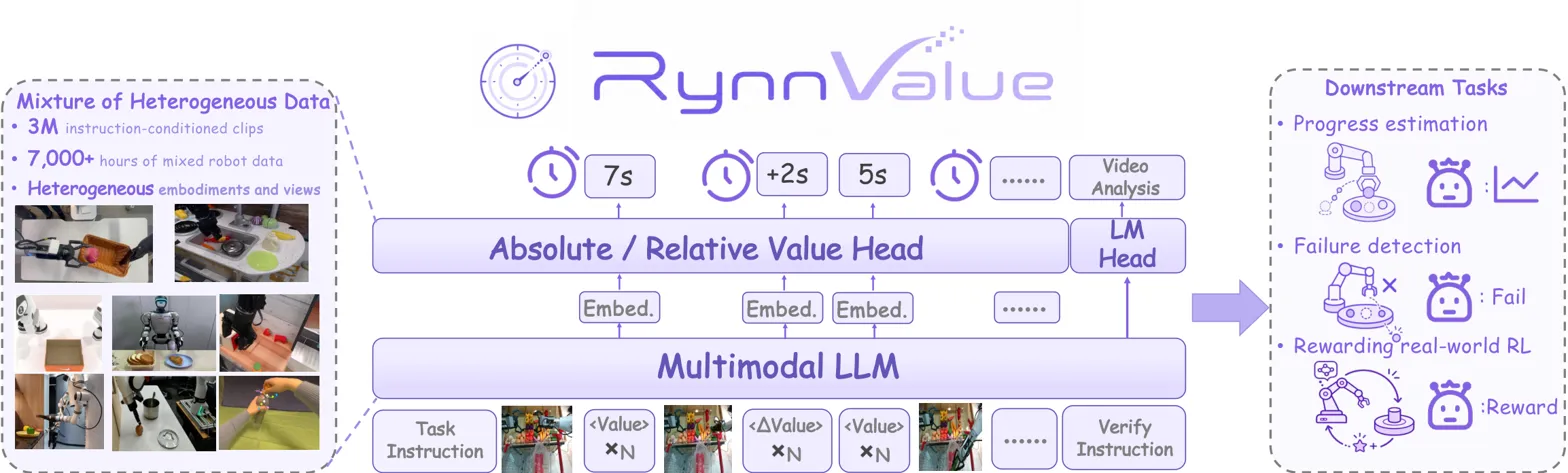
What it is
A robot value foundation model that learns goal-conditioned cost-to-go from timestamp-derived temporal distance instead of preferences or normalized progress, then turns it into dense rewards. Instead of preference labels or intra-trajectory progress, it learns language-conditioned temporal distance to goal directly from timestamps at scale. It adds shuffled temporal sampling and value-isolation attention so values stay grounded in visual evidence, including failures and regressions.
Key results
- 0.675 tau_a on RBM-EVAL-OOD vs 0.655 preference-supervised SOTA
- More than 2x progress-only baseline on RBM-EVAL-OOD: 0.675 vs 0.292
- Real-world success rose 52.5%→72.5% online and 63.8%→82.5% offline
Temporal distance is a scalable supervision target for robot value models and a practical dense-reward interface across heterogeneous data.