
What it is
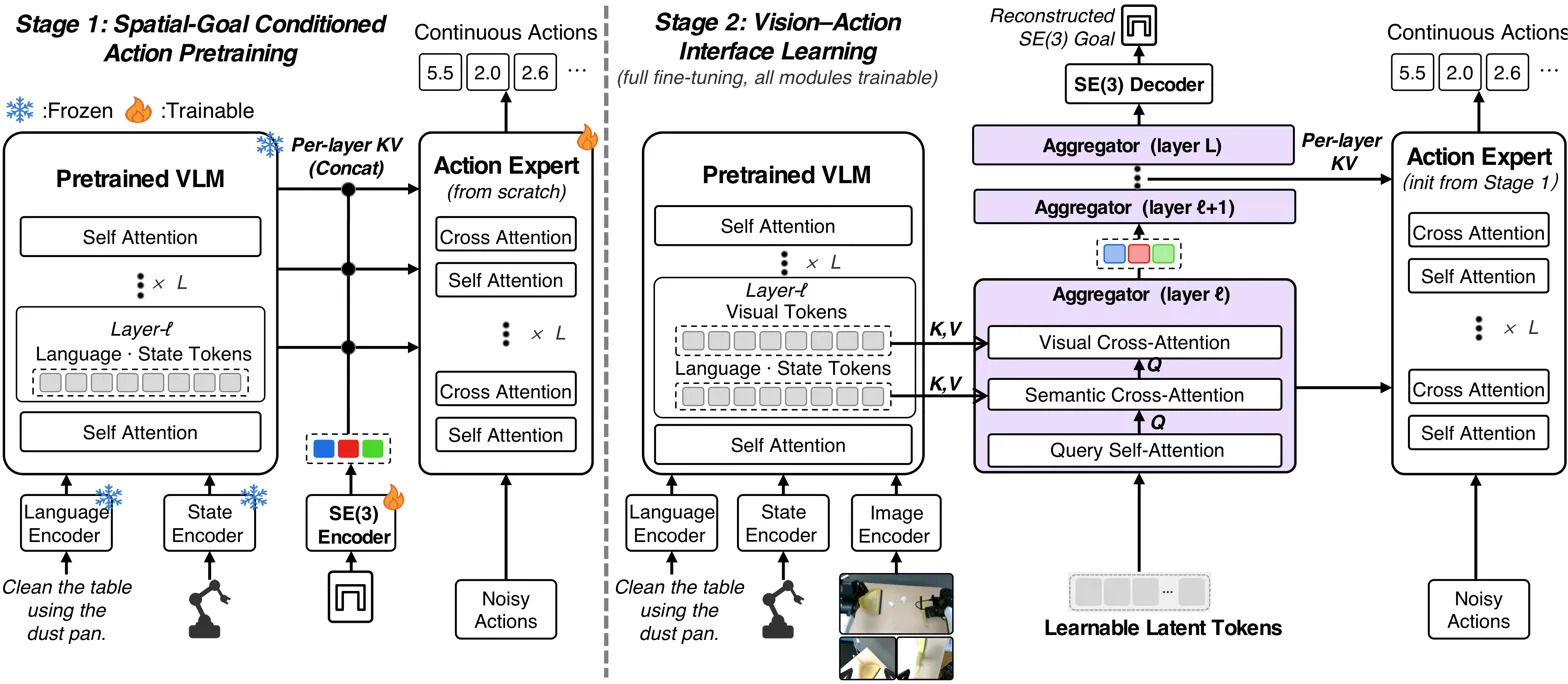
A two-stage training scheme for robot foundation models that blocks direct visual-to-action shortcuts by learning actions from spatial goals first, then forcing vision through a pose-supervised latent interface. Instead of letting actions read rich visual features directly, it first learns a goal-conditioned action prior without images, then allows vision only through latent tokens trained to reconstruct terminal SE(3) pose.
Key results
- LIBERO-Plus overall success rises by 3.87-10.70 pts across 4 models
- Real-world success improves by 13.30-16.70 pts under unseen shifts
- LIBERO avg improves on all 4 models, e.g. pi0.5 87.75% -> 91.80%
Constraining visual conditioning through a spatially supervised bottleneck reduces shortcut reliance without sacrificing in-distribution control.