
What it is
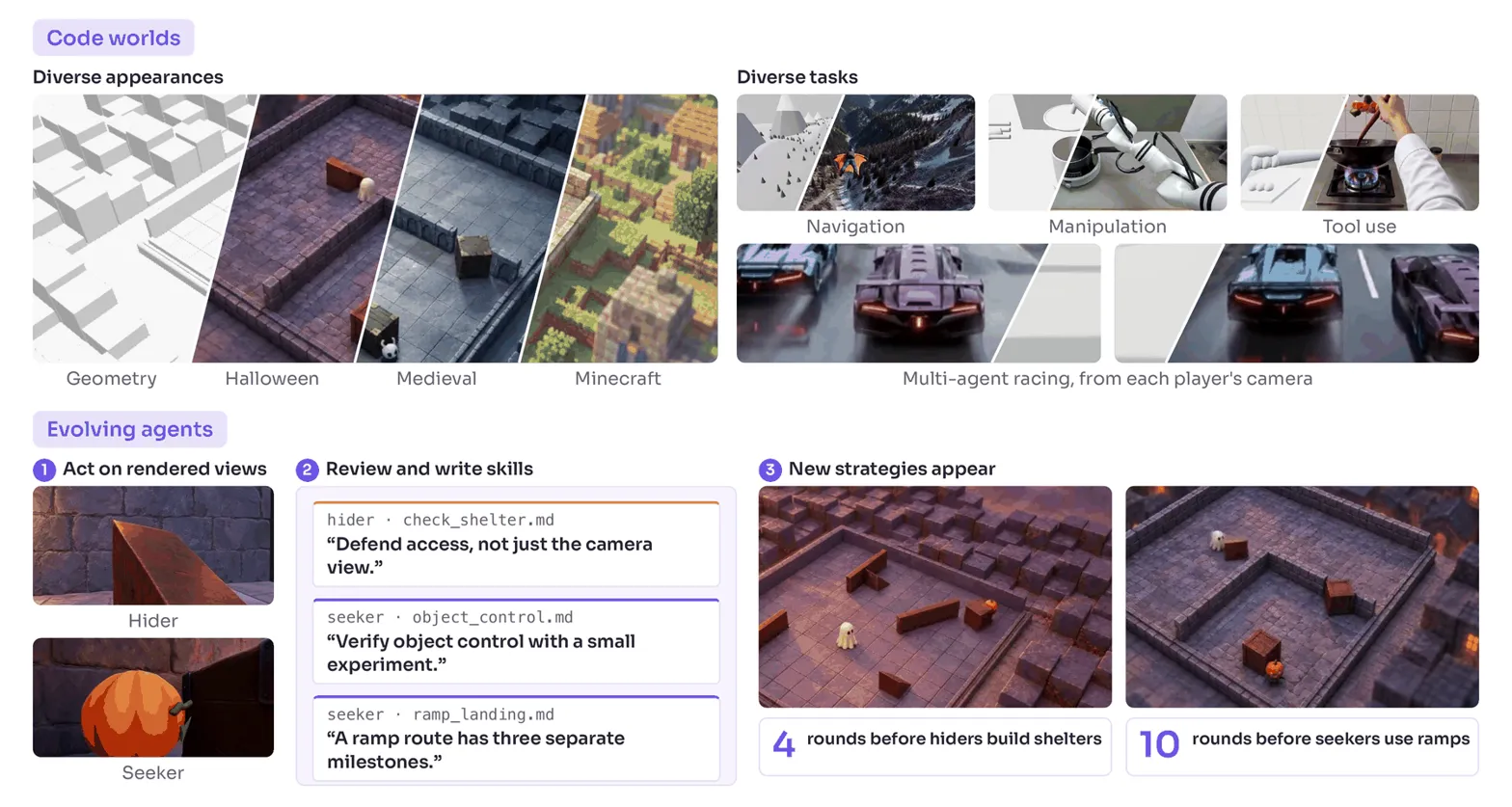
Builds interactive code-defined worlds by pairing explicit simulators with a shared neural renderer, then studies agents that improve across rounds via inherited playbooks. Instead of choosing between programmable simulators and realistic video world models, it splits them: engines keep explicit state/rules while one real-time neural renderer turns geometry conditions into visuals. It adds Adversarial Forcing to distill a pretrained video model into a few-step interactive renderer.
Key results
- Agents learn in 4 rounds vs millions for a conventional RL counterpart
- Shelter-building emerged after 4 rounds in hide-and-seek
- Seekers learned ramp use after 10 rounds in hide-and-seek
Shows that explicit simulators plus a shared neural renderer can make interactive worlds both programmable and visually rich enough for rapid agent skill evolution.